

Now that we know the angle a wave breaks at has a large say as to how it rides, it is worth looking at a shape that reliably produces a good peel angle. When a bank is shallow in the middle, deeper on both sides, and curves back toward the beach at either end, the classic “horseshoe” shape, we tend to get good waves. A wave coming in over it runs out of depth at the peak first, and the break walks outward from there in both directions, leading to an A-frame.
What makes the horseshoe different from other shapes is that the peel angle changes along the ride. It starts at zero at the peak and opens up as the break walks outward along each arm.
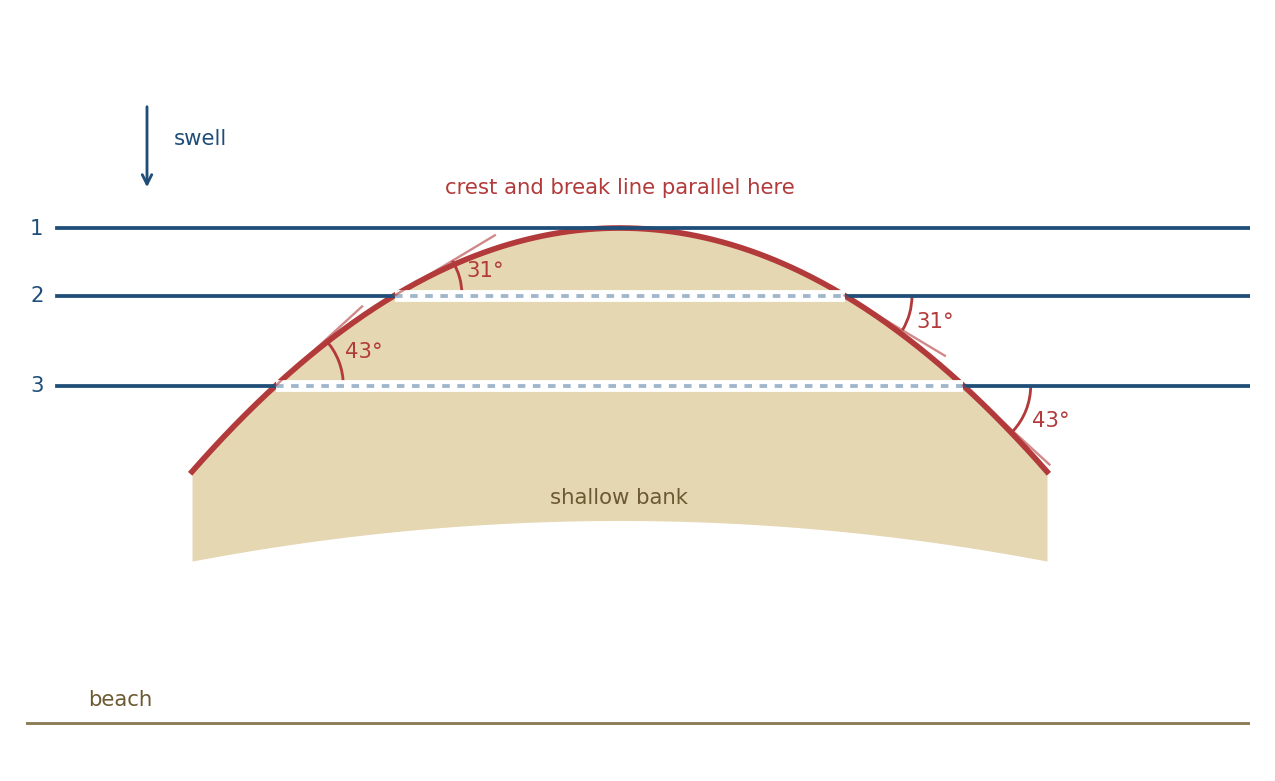
In the figure above, the blue lines are the crest at three moments as it comes in. They are drawn straight, since by the time a wave is this close to the beach refraction has already done most of its work. The red line is the edge of the bank where the water is shallow enough to break the wave. At the peak the crest and the red line are parallel, so the angle between them is zero and that part of the wave breaks all at once. That is where these waves start to throw their lip.
As the crest keeps coming in, it meets the bank further out on each arm, where the edge has curved back toward the beach, and the angle between the crest and the edge opens up. In the drawing it goes from zero at the peak to around 30 degrees and then past 40.
What this looks like from a surfer’s perspective is a steep drop where the angle is near zero, a fast section right after it, a wall you can work as the angle passes through the range from last week, and a shoulder to kick out on as the arm drops into the deeper water on either side. A beautiful ride, and in this case, symmetrical on the left and right.
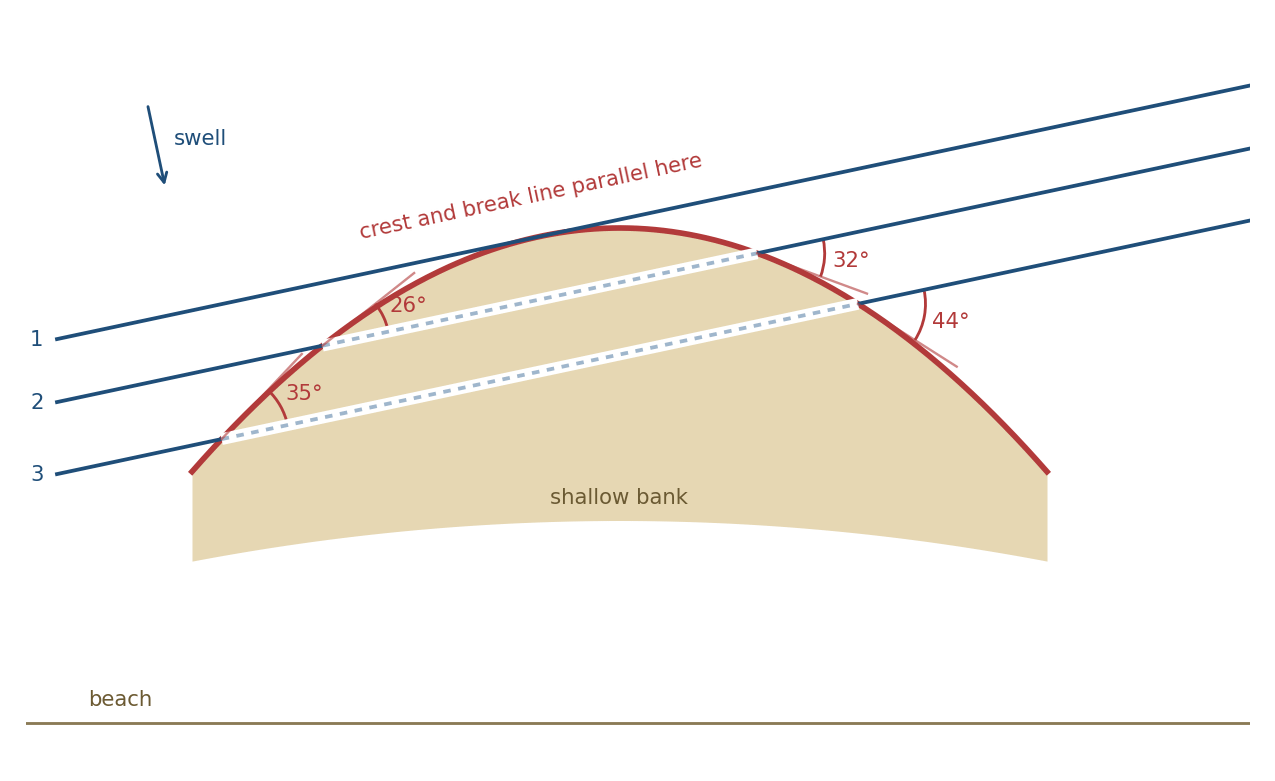
Let’s say the wavefront hasn’t fully refracted or the horseshoe isn’t directly perpendicular to shore. When the swell arrives at an angle, the crest meets the bank off center. The peak shifts toward the side the swell is coming from (the left in the figure above), and the two arms get different angles, because on one side the crest and the bank edge are lined up with each other and on the other they are working against each other. In the second figure the left runs at around 25 to 35 degrees and the right at 30 to 45, so the left is the faster wave. This is why one direction is better than the other on a given swell, and why the same bank can favor the other direction a week later when the swell has swung around.
The curve does one more thing, and it is why the peak is bigger than the shoulder. Shallow water slows a wave down, so the part of the crest over the middle of the bank falls behind the parts over the deeper flanks, and the crest bends in toward the apex. The direction a wave carries its energy is the direction the crest is facing, so a crest bent inward sends energy inward, and more of the wave arrives at the peak than would have if the bottom were flat. The peak is taller as well as shallower, and that forces a bigger lip.
So two factors make a difference here: one, the peel angle evolves during the ride which creates makeable sections, and two, the shape focuses wave energy at the takeoff, leading to a lip you can duck under on a good day.
Further Reading: