

Low tide beach break is generally forgiving. Waves crumble across a wide, flat stretch of sand before the swash reaches your ankles, and what returns to the sea is barely noticeable. But, if you’ve ever gotten clapped by some backwash at high tide, you know there’s something else going on. From peaceful sound machine to adversary, the change in backwash from low to high tide happens for a reason.
The reason is that you’re not standing on the same beach, not really at least. Most sandy beach profiles are concave. Down near the low tide line, the slope might be two or three degrees. Up near the berm, where the high tide waterline sits, it can steepen to ten or fifteen. When the tide rises, waves stop interacting with the flat part and start hitting the steep part.
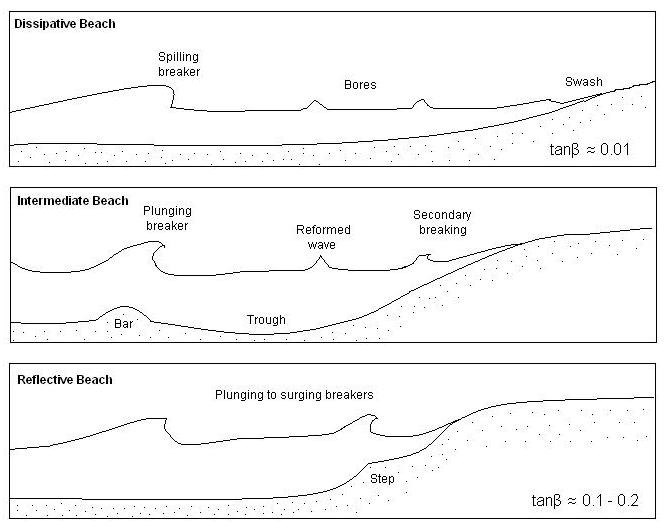
How a wave breaks depends on the relationship between the slope it encounters and its own steepness. There’s a ratio for this called the Iribarren number. A low Iribarren number, meaning a gentle slope relative to the wave steepness, produces spilling breakers. These are the mushy waves that crumble gradually and spend their energy across a wide surf zone. A high Iribarren number, steep slope relative to the wave, produces surging or collapsing breakers. These waves don’t fully break. They charge up the face and reflect back, sometimes retaining more than half their energy.
At low tide on a gentle slope, a wave might break fifty meters out and spend itself gradually on the way in. At high tide on the steep upper beachface, that same wave surges up a few meters of sand and comes right back. The energy that would have been chewed up by friction and turbulence across a wide, flat surf zone instead bounces off the steep face like sound off a wall. When that reflected water meets the next incoming wave, the two collide and stack. If you happen to be in the right place, you get launched.
That collision point also builds what’s called a beach step, a submerged ledge of coarse sand and shell at the base of the beachface where the backwash vortex dumps the heaviest material it’s carrying. It’s the little shelf you trip over wading out at high tide that doesn’t seem to be there at low tide.
Reef breaks get some backwash as well, but through a different mechanism. Roughly speaking, a reef is a fixed ledge. The slope doesn’t change with the tide, so the Iribarren number stays about the same. Backwash at a reef break has less to do with the reef and more to do with what’s behind it. If the wave breaks on the reef and the remaining energy runs into a cliff, a seawall, or a steep rocky shore, it reflects. At low tide though, this reflector may be out of the water and not reachable at all, so no backwash.
Further Reading: