

It might be embarrassing to admit: I ride a channel-bottomed board and I can’t feel them. The six parallel grooves cut into the back third of my board are doing something to the water flowing past, but whether they’re doing what shapers claim is harder to pin down. There isn’t much science on channels, and what gets repeated about how they work doesn’t always match the geometry sitting under your feet.
Most channel boards have four or six grooves running roughly parallel toward the tail, starting somewhere around the front fins and exiting at the back. The pitch is just short of a miracle cure: they generate lift by compressing water flow, push water toward the tail for “drive,” add bite on rail, and cut through tail rocker to flatten the back of the board. Like most cure-alls, these qualities don’t all hold up equally well.
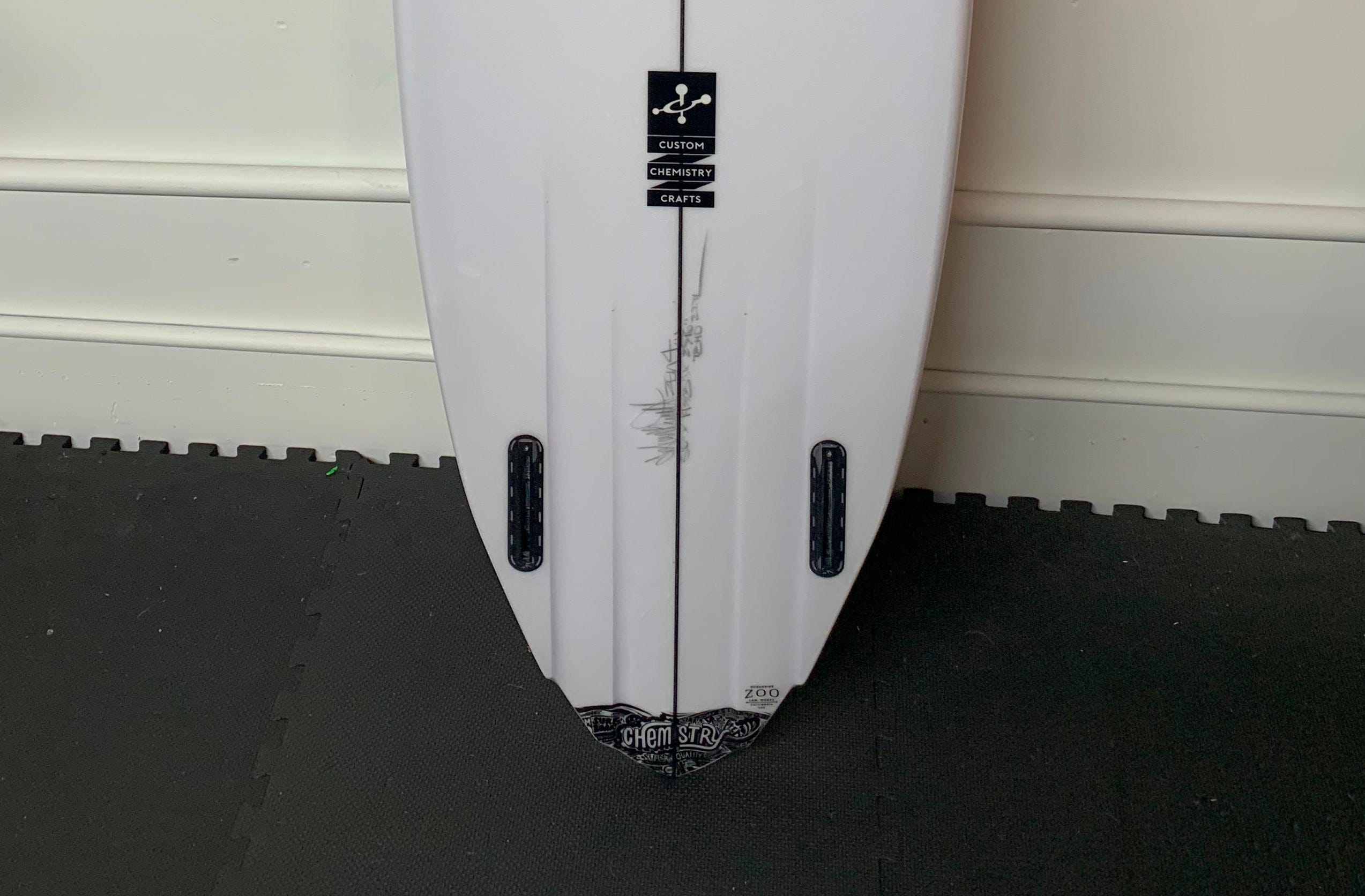
The first issue is that parallel walls don’t compress flow along the length of the board. The compression-creates-lift story gets borrowed from single concaves, where a curved, narrowing surface really does squeeze water toward the tail, drop the pressure, and push the board up. That mechanism needs the curve to work. Channels run flat-walled and parallel, which is the geometry that doesn’t compress flow in the direction it matters. The Bernoulli explanation that fits a concave bottom gets applied to channels too, even though the shape isn’t doing the same thing.
The rocker effect is the part that holds up. Cutting half-inch grooves through a curved tail leaves a series of flatter planing surfaces in the back of the board, while the rail rocker stays kicked up where it needs to be for turns. Less curve under the planing surface means earlier planing and less drag at speed. It might be the most defensible thing channels actually do. Some shapers describe channels as a way to run extreme tail rocker without the board bogging under the back foot, which is the same effect in “feel” language.
When we search the peer-reviewed literature for surfboard hydrodynamics, we mostly find fins. Multiple CFD studies on three-fin and four-fin configurations, grooved fin designs, fin position, even pressure sensors embedded in fins on a river wave. But bottom contours barely show up. The closest thing to a direct test on channels is Riccardo Rossi’s CFD work for Firewire, where the channel-bottomed Sci-Fi showed lower drag and friction than the rounded-tail Omni, with the tail channels credited as a key factor. The boards also differed in tail shape and rocker, so the channels weren’t cleanly isolated. The same testing found that half an inch of tail rocker shifted dynamic lift by about 50%, which makes the rocker-straightening case stronger than the flow-compression one.
Despite the lack of literature, people still chase down channel-bottomed boards for heavy hollow waves in Western Australia and Indonesia, and the design hasn’t gone away despite half a century of competing alternatives. That kind of long anecdotal record carries real signal, just not the kind a controlled experiment would.
A study of two identical boards differing only in whether they have channels, tested side by side, has never been run. This would help close the gap between how confidently channels get explained and how little has actually been measured.
Further Reading:
You missed the most important thing about channels. They look bad ass.