

For our 100th article here, we’re going to try to answer this question that has been on my mind for about 5 years now. Or, at least we are going to start to knock out possible explanations. To my knowledge, this hasn’t been studied, so let’s explore it together.
A big set rolls through, and for about a minute after it passes, the surface where it went is glassy. The wind chop is just gone. Then the wind rebuilds it and we’re back to the chop. The wind never let up the entire time, so it isn’t that causing it. It really does look like the big wave annihilates it.
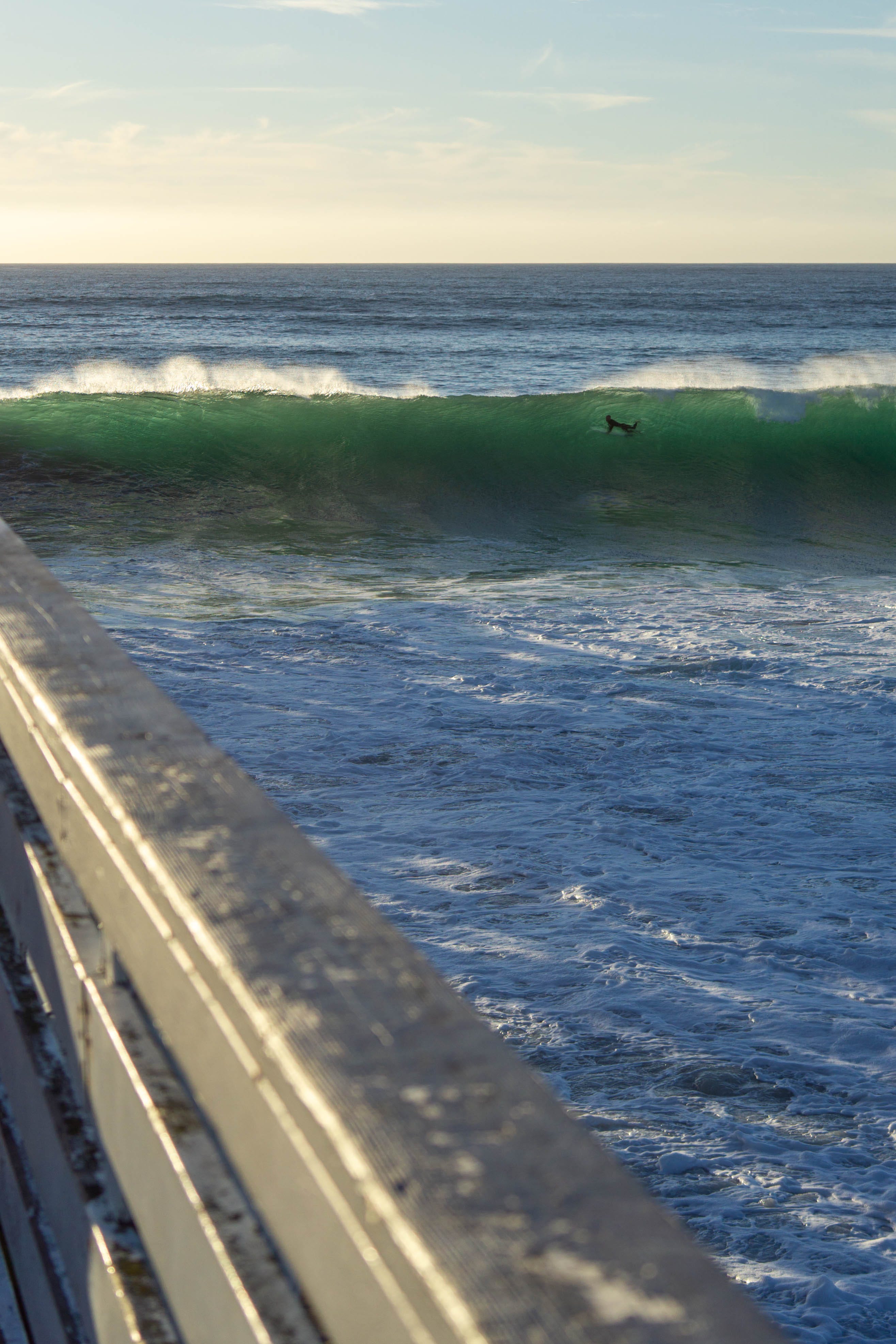
My first thought is surface tension. Think of pulling a wrinkle out of a sheet by stretching both ends. But, it just can’t be the answer. Surface tension only governs the smallest ripples, the capillary waves shorter than about 1.7 centimeters, where the water really does behave like it’s straining against itself. The chop getting wiped out is bigger than that.
Next thought, Doppler shifts. A big set shoves a mass of water toward the beach. A current running with the chop will stretch the wind waves out longer and lower, which is a real effect. The problem is two-fold. The surge, and the backwash that follows it, relax in seconds, ten or twenty at most, while the glass hangs around for a minute or two. And stretching the chop doesn’t erase it. You’d be left with longer, mellower waves, not the flat water we actually see.
Now, we aren’t totally in the dark, because we know how to make glassy water in other situations. Convergence zones pile up the thin organic film on the surface and damp out the ripples, the same effect that draws those slick lines off internal waves. But it doesn’t give an obvious reason for a one-minute patch that shows up the instant a set breaks. There’s nothing about a passing set that should concentrate and hold a film against a wind that’s actively working the surface.
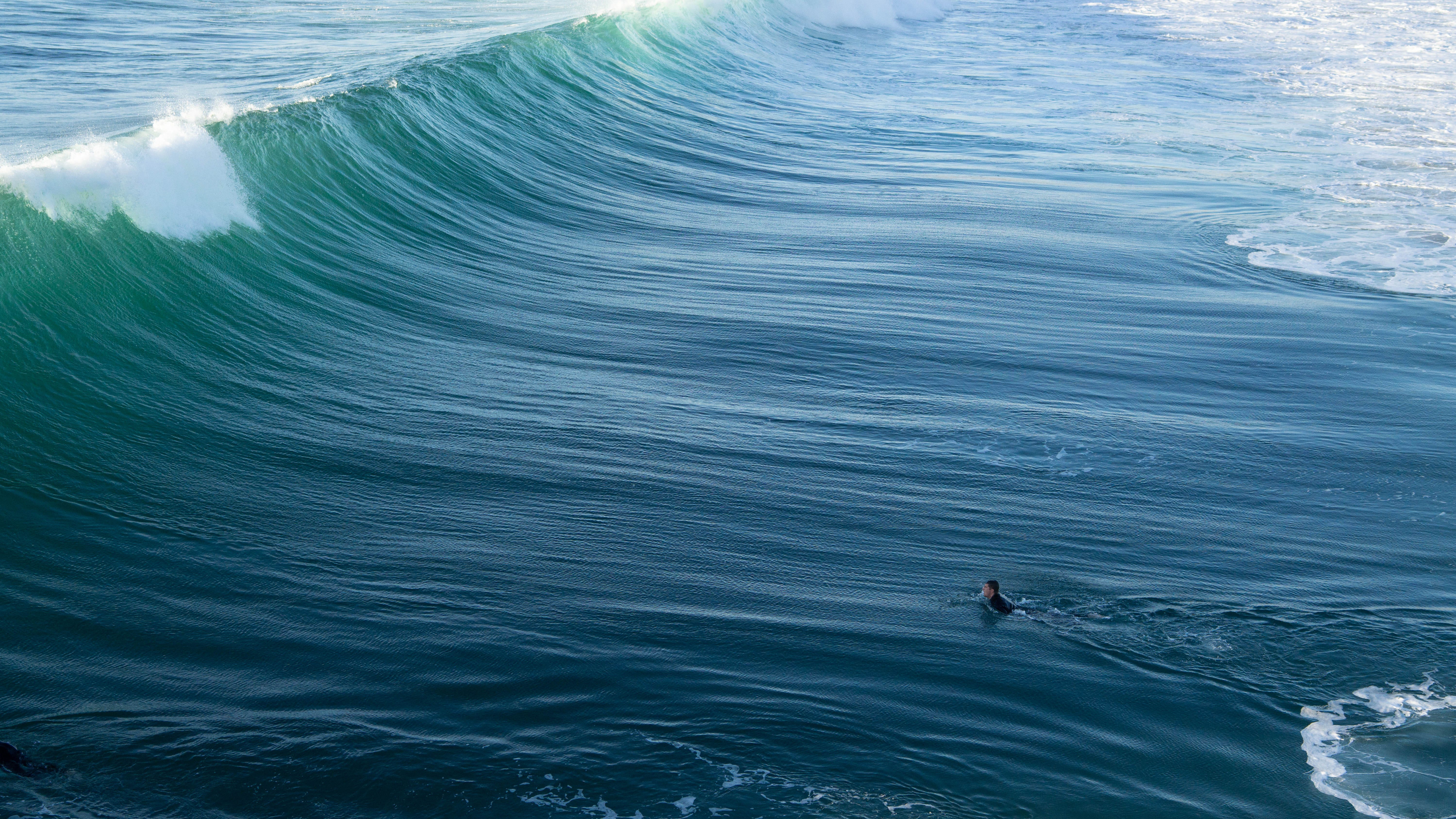
As of now, my thinking is focused on bubbles. When the set breaks, it drives a plume of air down under the surface and leaves a raft of foam behind. Bubbles near the surface can damp short waves, and this is the guess whose timescale actually fits, since a bubble raft lingers for tens of seconds. These trapped air bubbles attenuate small surface waves by dissipating their energy, knocking down the wind chop.
There’s even precedent for this idea, just in a different context. One proposed explanation for how rain calms the sea is exactly this, the drops forcing air bubbles under the surface to soak up the chop. But, nobody has measured it in the surf, and if bubbles were the whole story the glass should sit only on the bubbly water, which isn’t always where you see it. As far as I can tell at least.
Each of these potential ideas has a hole in it, and it seems to be an open question. So keep an eye out for this smooth lull and let me know if you have any ideas as to what is causing it.
Thank you all for reading 100 of these. I’m excited to continue on with more surf science and welcome any questions you’d like answered.
Further Reading: