

Wiping out on an average day tends to leave the ocean spitting you back out pretty quickly. You’re wearing a few millimeters of neoprene, you grabbed a breath on the way down, and the water around you is denser than you are, so up you go. The whole thing usually takes a second or two. But some waves keep you under noticeably longer than others of the same size.
Broken-wave water is full of air. Void fraction, the share of a volume that’s air rather than water, can reach roughly 65% in the collapsing cavity just after the lip lands. It holds above 20% through the mixed region below, and it lingers, because bubbles take time to rise up and out. For a stretch of seconds, you are immersed in a seawater-foam mixture.
This mixed fluid has a different density than straight seawater, significantly lower. In still water, a wetsuited surfer with full lungs runs a little less dense than seawater, which is the reason we float. But if the density of the surrounding water drops by a fifth, the margin can shrink or even flip. Water/foam beats surfer.
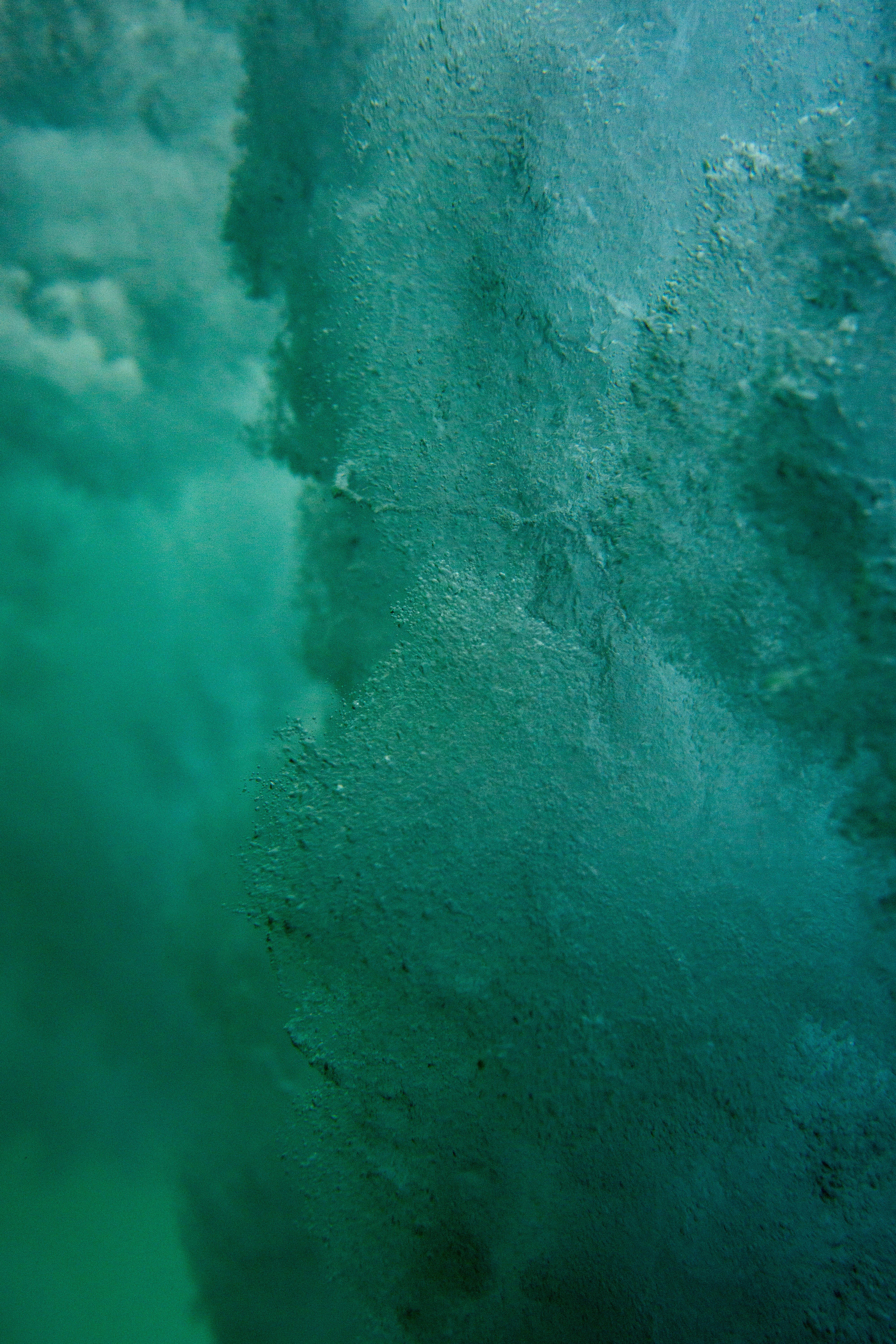
But less float doesn’t really explain the feeling of being stuck near the bottom, waiting for permission to leave. A hard plunging wave does drive some air down with it, enough to dent your buoyancy at depth, but the foam thins the deeper it goes and can’t account for all of it. So what is actually holding you down there? In shallow water, where the column is thin enough for the wave to reach the bottom, it comes down to where the wave dumps its energy.
When a wave pitches out and lands, it throws a jet of water down into the column ahead of it. In a strong plunging wave, the vortices that the jet spins up penetrate nearly the whole depth as soon as the wave breaks. The vertical velocities inside these bursts run larger than the wave’s own orbital motion, an order of magnitude above the turbulence ordinary bottom friction makes, somewhere around 1 m/s in surf-zone measurements. This speed is in the same range as the speed your buoyancy lifts you, so it is possible that it actively pushes you down.
This is likely why two waves of the same height treat you so differently. A wave that stands up and throws its lip forward, the way it does over a shallow reef or a slab, drives that jet deep and stirs the whole water column at once. A wave that slumps and slides down its own face on a gentle sandbar spreads its turbulence slowly and weakly, and leaves the water near the bottom mostly alone. Face height is the factor that many would assume to be the biggest driver, but whether you get parked on the bottom also depends on how the wave breaks, which is mostly a question of what the seafloor looks like where it does. 3ft shore breaks have hit me way harder than 8ft crumblers.
In summary, the answer is two-fold. Waves plunge water and air down into the water column, both actively pushing you down and taking away your buoyancy at the same time. Just remember to count in your head, it’s never as long as you think down there.
Further Reading: