

A Kelvin wave is a long wave held against a boundary by Earth’s rotation. It is a form of trapped wave, similar but distinct from those that led to my PhD in Oceanography. In the Northern Hemisphere, the Coriolis effect deflects moving water to the right, so water moving along a coast with land to the right is pushed into it. The sea surface tilts up toward the coast until the pressure from that slope balances the push. The result is a wave that is largest at the boundary, decays offshore, and travels in only one direction, with the coast on its right in the Northern Hemisphere.
The equator can act as that boundary because the Coriolis effect changes sign across it, so water drifting off to either side is turned back toward the equator. Equatorial Kelvin waves travel east only. During El Niño, the trade winds weaken, and warm water that had piled up in the western Pacific moves east as a Kelvin wave, raising the sea surface and pushing the thermocline deeper as it goes. Their trip across the Pacific generally takes two to three months in contrast to the hours it takes for a tsunami to go the same route.
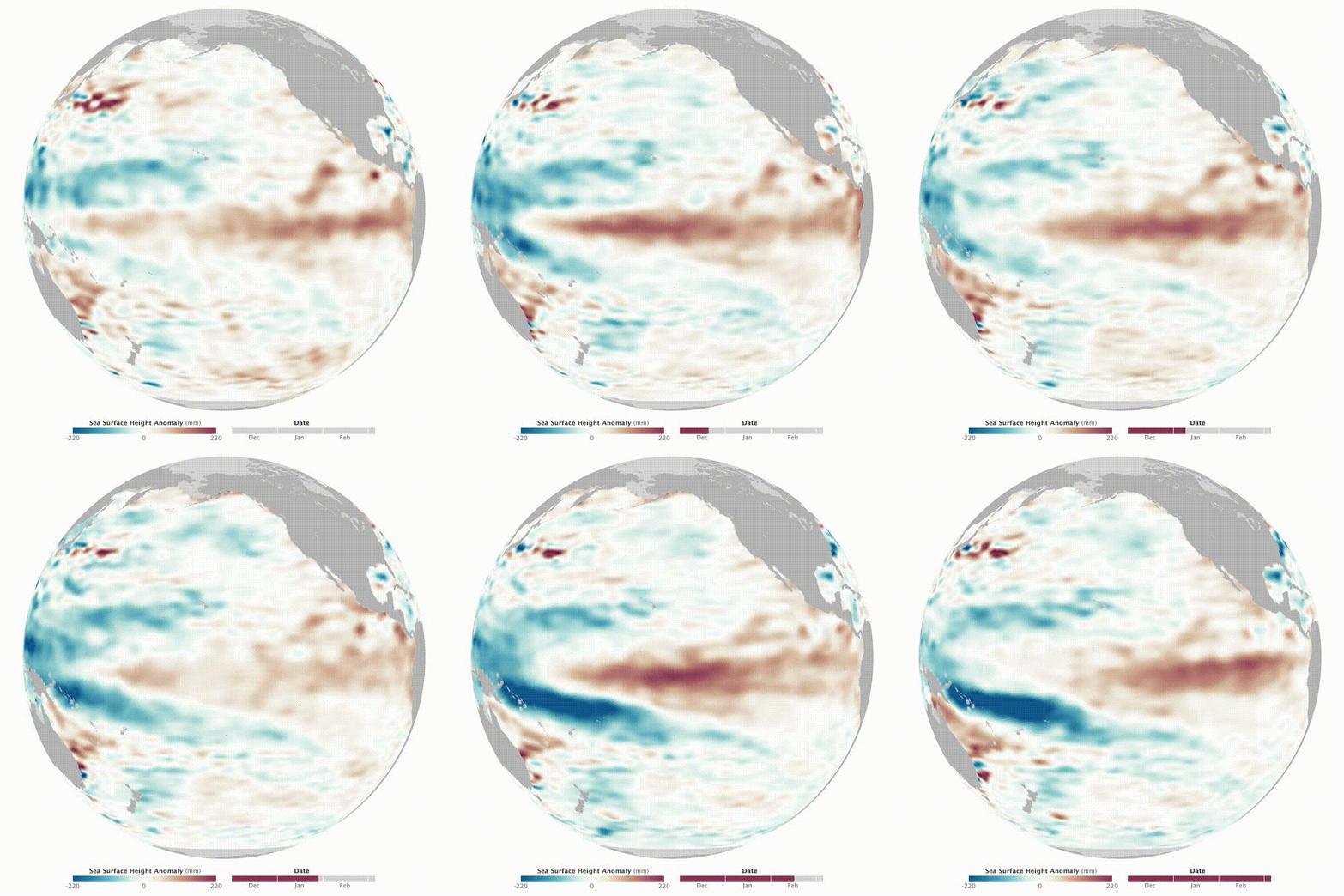
When the wave reaches the Americas, its energy turns poleward along the coast in both directions. The northern branch travels along Central America and Mexico, around the Gulf of California, and up Baja to Southern California. Once it is on the continental shelf, it travels as a coastal trapped wave, no longer an equatorial trapped wave.
During the 2015-16 El Niño, mean water levels in Southern California ran 15 to 25 cm (about 6 to 10 in) above normal, with a maximum of 39 cm (about 15 in), similar to previous El Niños (Young et al. 2018). Coastal Kelvin waves are one contributor to that rise, and thermal expansion of the warmer water is another. Tide predictions are based on astronomy alone, so none of this shows up in tide tables or surf apps.
For scale, the great diurnal range at La Jolla, the difference between mean higher high water and mean lower low water, is 5.33 ft (1.62 m). A 15 to 25 cm offset is about 9 to 15% of that range, not massive but it is additive. Low tide spots will get more water over them, and high tide reaches the steeper upper beach more often, which, as we saw with backwash, means more reflection off the beach.
The effects are largest when the anomaly stacks with other factors. On November 25, 2015, La Jolla recorded 7.81 ft above mean lower low water, the highest level on NOAA’s record for the station. Young et al. attribute it to the El Niño anomaly, a high tide, and the long-term rise in sea level, with incident waves of only about 2 m that day. A coastal Kelvin wave is expected this fall, so the entire tide swing will be raised up by a few inches.
These waves, just like the tides on our Pacific coast, travel north towards the pole. Each wave can keep the water high for weeks, and rather than having a decrease below the mean level, the downturn of the wave tends to put it back towards normal. Expect some higher tides for the next season, but not much more than a big tide shift. The danger of these ones are the stacking of tide, storm surge, and swell, which add to potentially flood low-lying regions. Stay safe and check out those high tide spots.
Further Reading: