

Surface waves break. It’s the whole reason any of us bother owning a surfboard. But sound is a wave too, and so is light, and it’s not obvious that they break. So is breaking something that water does, or something that waves do?
The definition of breaking is more specific than a wave falling apart. A water surface wave is a shape moving through the water while the water itself mostly stays put, circling in place and ending up about where it started. Breaking is when that stops being true. The water up in the crest gets moving nearly as fast as the shape is traveling, runs out of wave to circle back down into, and just keeps going forward on its own.

All it requires is that the wave's own size changes how fast it travels. Big parts have to travel at one speed and small parts at another.
A few hundred meters down, warm water sits on top of cold water, and waves run along that boundary the same way surface waves run along the boundary between water and air. The two layers differ in density by a fraction of a percent instead of the factor of eight hundred between water and air, so gravity makes the waves come out enormous and slow. The biggest we’ve measured stand over two hundred meters tall. They shoal up the continental slope, they steepen, and when the water inside one catches the wave, they break. The overturning lip can be a hundred meters of it, with nothing on the surface to show for it but a slick.

In a sound wave the air moves back and forth along the same line the wave travels, not in circles across it. Even though the waves are fundamentally different forms, again, what matters is only whether a wave’s size changes its speed.
The squeezed parts of a sound wave are denser and warmer than everything around them, and the air in them is itself moving forward. Both make that part of the wave travel faster, the motion more than the warmth. So the loud part is always gaining on the quiet part in front of it, barely, for as long as the sound is traveling. Every loud sound leans forward as it goes, and given enough distance, they all end up in the same shape, a sawtooth, no matter what they started as.
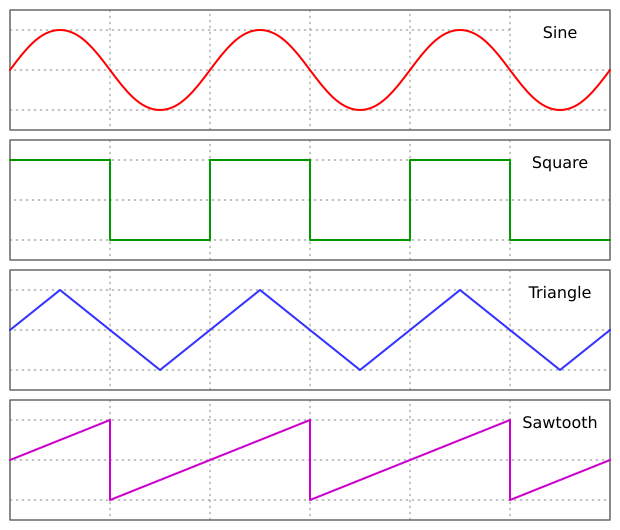
You’d think the front would eventually fold over itself, but that would mean the air pressure at one spot had three different values at the same time. Air doesn’t do that. So instead of a fold you get a cliff, with the pressure jumping from one value to another across almost no distance. This is called a shock, and thunder, sonic booms, and the crack of a whip coming off a tip that went supersonic are all examples of one. It’s the sound wave’s version of breaking.
Brightness doesn’t change the speed of light in empty space. A bright patch of a light wave travels exactly as fast as a dim one, so the bright part can never gain on the dim part, and nothing ever leans. Quantum effects break that rule at some field strengths, but for any practical purpose, light in a vacuum is the one wave that isn’t allowed to break.
Pushing enough light through glass, though, causes the light to slow down where the beam is brightest. Intensity starts setting the speed, and the leaning starts up again, backward this time. The bright peak lags its own dim edges, so the back of the pulse steepens toward a cliff of its own, an optical shock.
In air, a pressure can’t hold two values at once, so a barrel gets replaced by a sonic boom. In water, a wave breaks as it does because the surface of the ocean is a shape hanging in space instead of a number at every point, and a shape has somewhere to fold into. Breaking is something waves generally do. A surface is just the only place with room to throw a lip. And light in a vacuum is just crazy.
Further Reading:
Very interesting. I've sat in halls with terrible acoustics, and i swear it sounds like the waves are all breaking and collapsing ontop of each other.