

When a wave breaks, the thing running down the line is the breaking point, not the water and not the wave. How fast this breaking point moves down the line is the actual difference between a good wave for beginners, pros, or just a plain closeout.
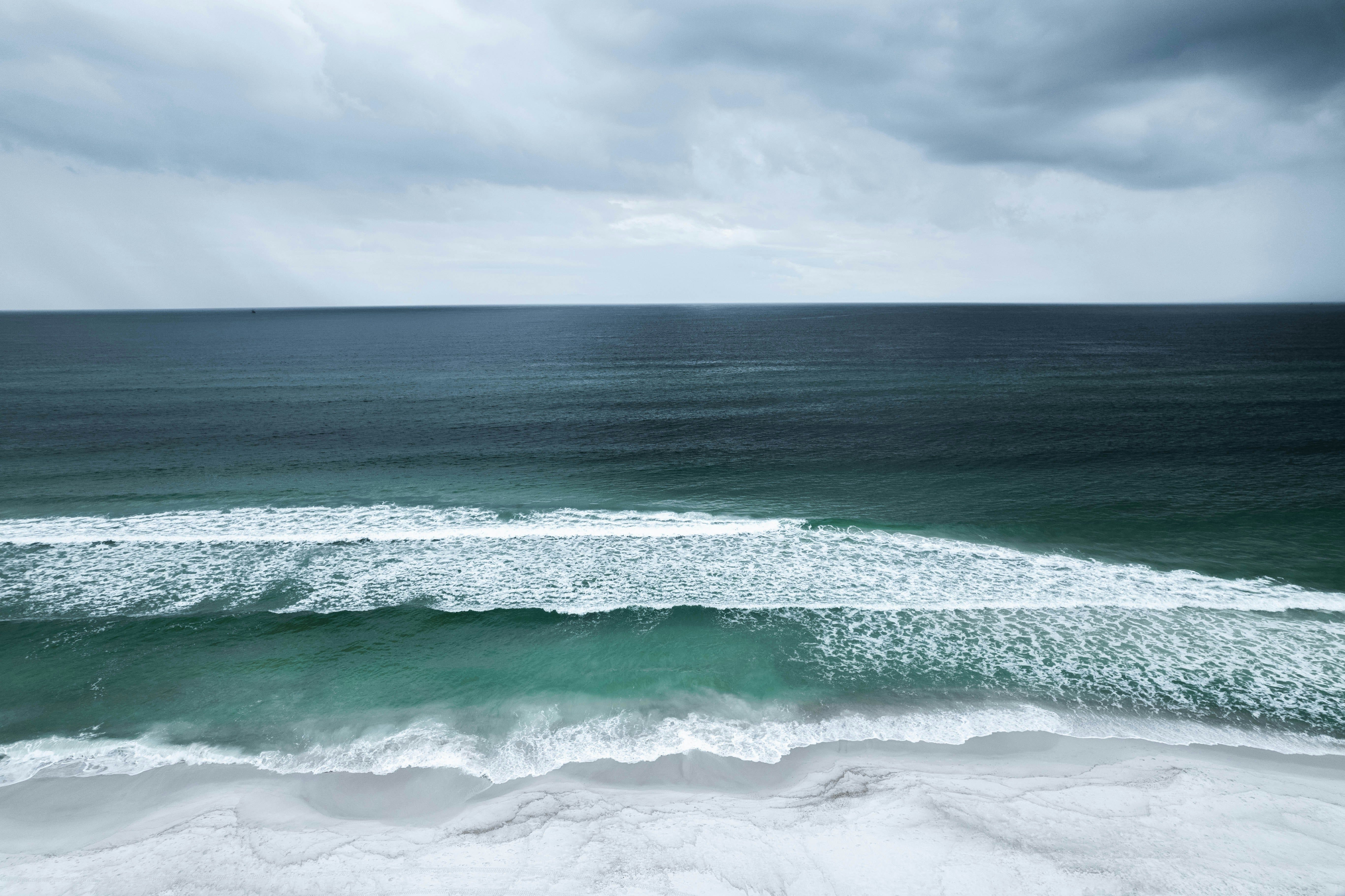
In studying waves, we tend to quantify this as an angle rather than a speed. Imagine hovering above the break and watching it roll in towards the beach. The angle that the white water makes with the crest of the wave is the peel angle. In this frame, zero degrees is a closeout, with all of the wave breaking at once and there being a line of white water parallel to the beach.
A higher peel angle, such as 60 degrees, means the wave is running out of depth progressively along its length rather than all at once. The break has to walk sideways down the crest to get to the end of the wave, and you get to ride ahead of it.
Let’s get a bit geometrical. If the wave is moving at speed c and the peel angle is α, the breaking point travels along the crest at c divided by the tangent of α. You have a harder job than the breaking point, because you have to move toward the beach as well as sideways, so your required speed is c divided by the sine of α. Both get larger as the angle shrinks. This means that as the angle gets smaller, you have to go faster. For a perfectly aligned closeout, you’d literally have to be moving infinitely fast to surf it all the way.
The practical floor for surfing was put at 30 degrees in 1974, from work out of the Look Laboratory at the University of Hawaii. Most of what we ride sits between 45 and 66 degrees. Above about 70 degrees, the wave stops peeling in any useful sense and crumbles toward the beach instead of down the line, which is fine for some white water surfing but not much more than that. Those numbers shift with wave size, since a bigger wave gives you a steeper face to drop down and more speed to work with, so an angle that shuts you out at two feet can be fine at six.
Peel angle also isn’t fixed along a single wave. The bottom changes underneath it as it comes in, and the angle changes with it. Where the angle drops, the break gets out ahead of you and you have a section to make. Where it rises, the break slows down and hands you a shoulder to work with. A wave that keeps collapsing and recovering that way is what we’re describing when we call a wave sectiony.
Swell direction has less to do with the angle at the break than you would think. Refraction turns the crest toward the beach for the entire time a wave is in shallow water, and by the time it breaks it has mostly finished the job. A long-period swell aimed 30 degrees off the coast arrives at around six, and no offshore direction gets it much past twelve. Both are effectively closeouts.
A wave breaks where it runs out of depth, so the line the breaking point traces is the depth contour where that happens, and the peel angle is the angle between the crest and that contour. Since refraction has already pulled the crest nearly parallel to the beach, what you are really measuring is how crooked the shallow ground sits relative to the shoreline. A point, a reef, a ledge, or a bank of sand angled across the beach all do the same job, holding a line that the beach itself does not. The shape of the bottom is the shape of your ride. The best shape for it is a curve, shallow in the middle and deeper on both flanks, but that will have to wait until the next one.
Further Reading: