

Rails are sold in adjectives. A shaper will call one full, pinched, hard, soft, or boxy, and a surfer will say how it feels under the back foot. Numbers are pretty much absent from the discussion.
To quantify some rail properties, I took a slice through the middle of a 6’0” shortboard, 47 centimeters wide with a flat bottom, and held it in moving water inside OpenFOAM, an open-source flow solver. Then I changed the rail and nothing else, and recorded the force the water put on the slice. There are 51 runs behind this piece: 21 with the slice skimming on the surface, which is where most of the numbers below come from, and 30 with it fully underwater.
This is the fourth piece in the First Order series, one question surfers have, answered in layers you can drag. Every rail I ran is in the Rail Lab, with sliders for shape and lean: open the Rail Lab →
Zeroth order: a flat board
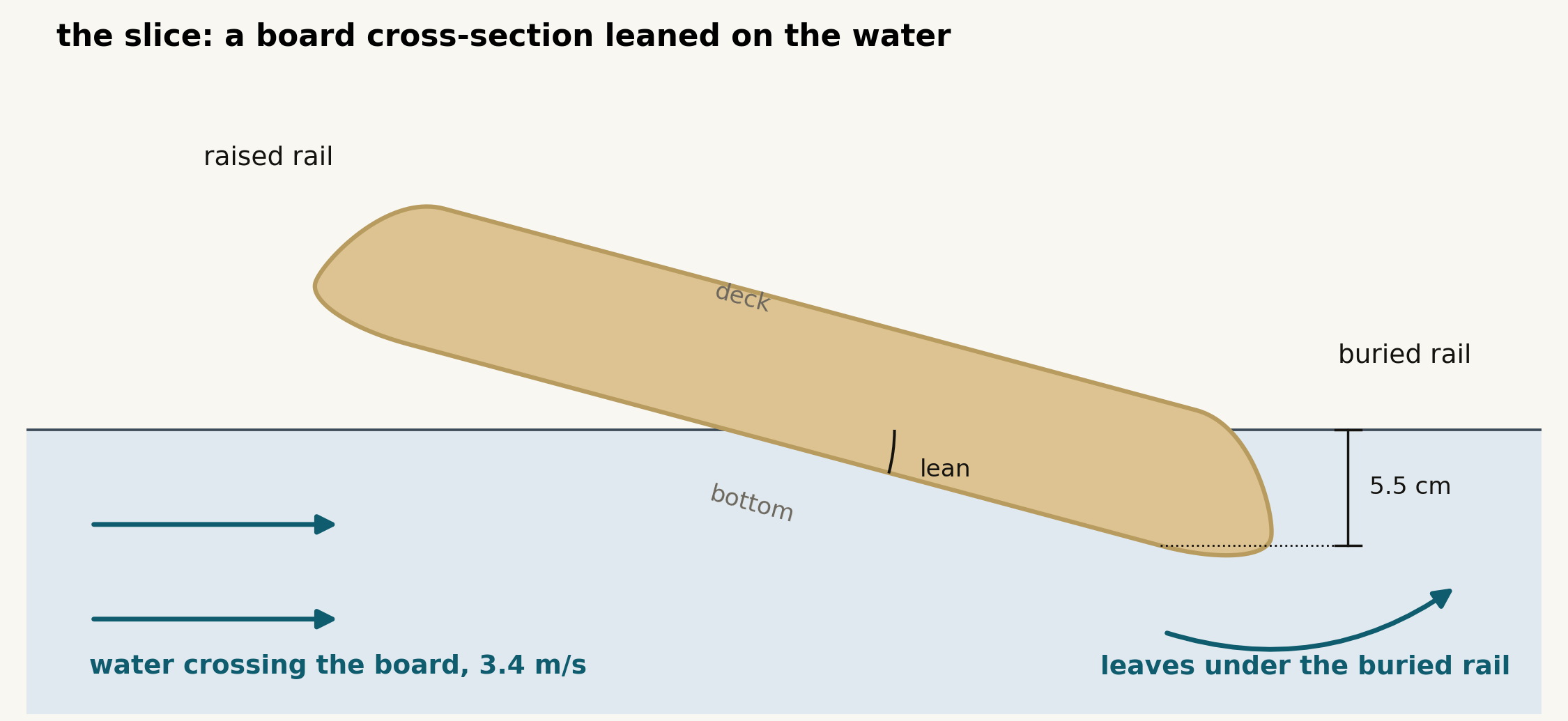
A surfboard at speed is planing. The bottom meets the water at a shallow angle and pushes it down, and the water pushes back up. A skipped stone stays on top of a pond the same way.
In a turn the board is leaned over with one rail buried in the wave face. Water climbing the face and the board’s own sideways slip both send water across the bottom, from the raised rail toward the buried one, and it leaves the board under the buried rail. For a typical bottom turn I chose that crossing speed at about 3.4 meters per second, or 7.6 miles an hour, and every run here uses it.
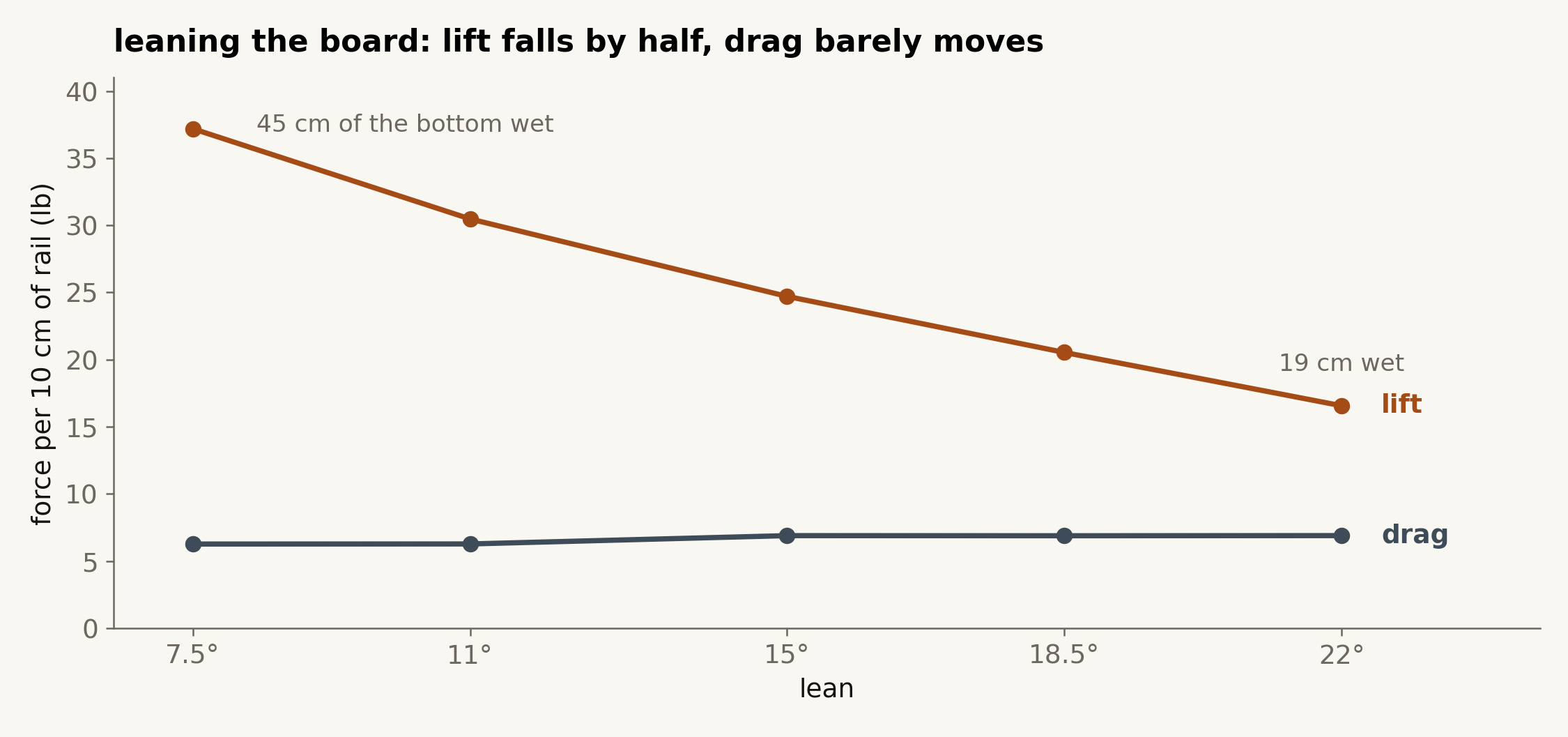
To zeroth order the board is a flat plank with no rail at all, and the only thing that matters is how far it is leaned. In the simplest case, I held the buried rail 5.5 centimeters under the surface. At 7.5 degrees of lean, the shallowest I ran, 45 of the slice’s 47 centimeters are wet and every 10 centimeters of rail length carries 37 pounds of lift. At 22 degrees, the steepest, 19 centimeters are wet and the lift is 17 pounds. Drag goes from 6.3 pounds to 6.9. Leaning the board takes away 55 percent of the force holding it up, before the rail has had any say.
First order: the board has an edge
A real board ends in a rail, a curve about 5 centimeters wide where the bottom rolls up into the deck. It is the last part of the board the water touches on its way out.
I ran three rails that differ in one measurement, the height of the widest point, which shapers call the apex. On the low rail the apex sits a quarter of the way up from the bottom. On the 50/50 it sits halfway. On the high rail it sits 70 percent of the way up, with a long rolled curve underneath it.
With lean, speed, and depth held the same, the low rail carries 24.7 pounds at 15 degrees and the 50/50 carries 21.3. That is a 16 percent difference in force from reshaping the last 5 centimeters of a 47 centimeter slice.
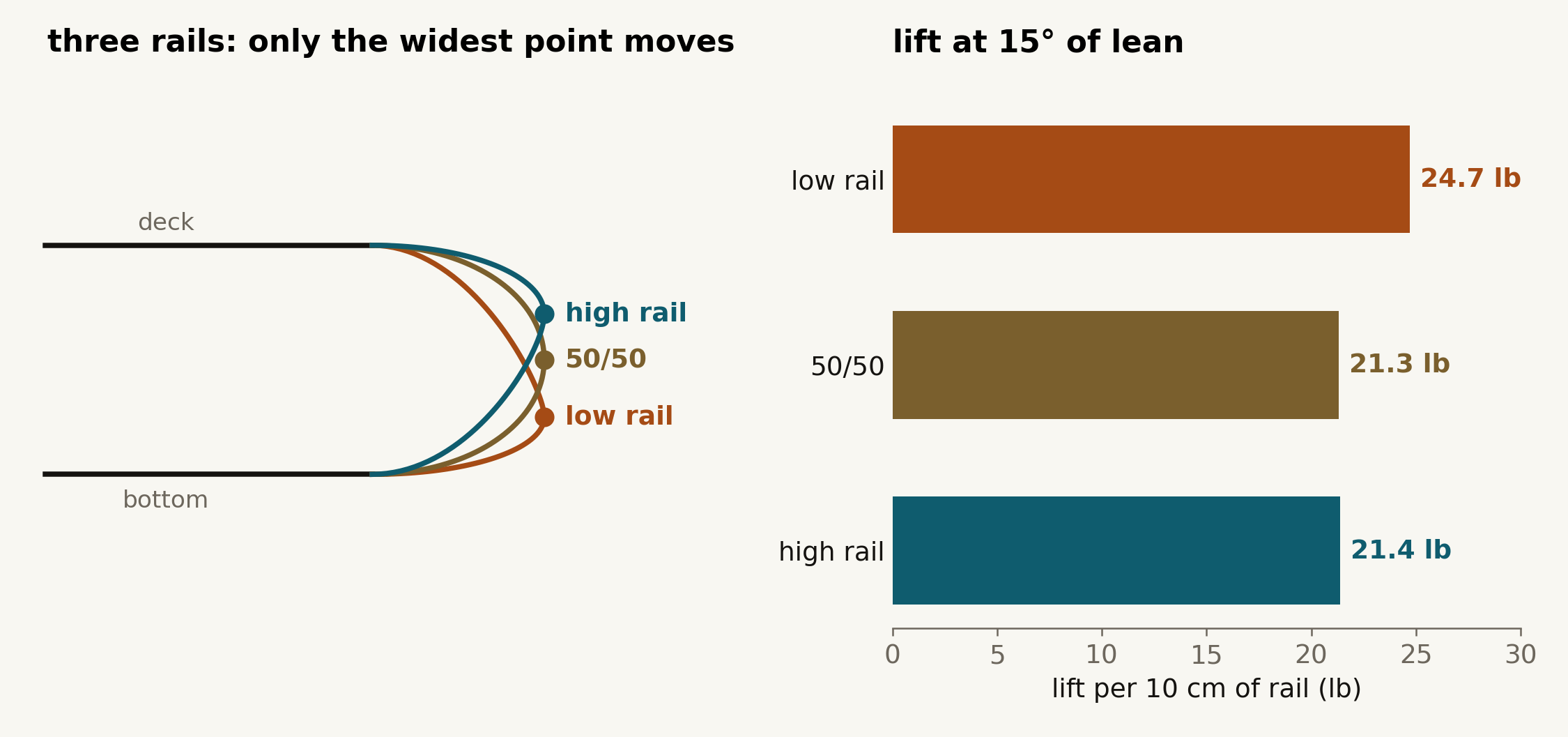
The three rails wet almost the same width of board, within 3 percent of each other, so the extra force has to come from pressure. Under the low rail the bottom stays close to flat nearly to the edge, and the water keeps pressing up on it. Under the high rail the bottom curls upward sooner, and in the solver’s pressure output the push fades about 3 centimeters earlier. Water tends to follow a gentle curve, and where it does, it pulls on the surface. The back of a spoon held in a running tap gets drawn into the stream for the same reason.
Higher orders: what you can do with the edge
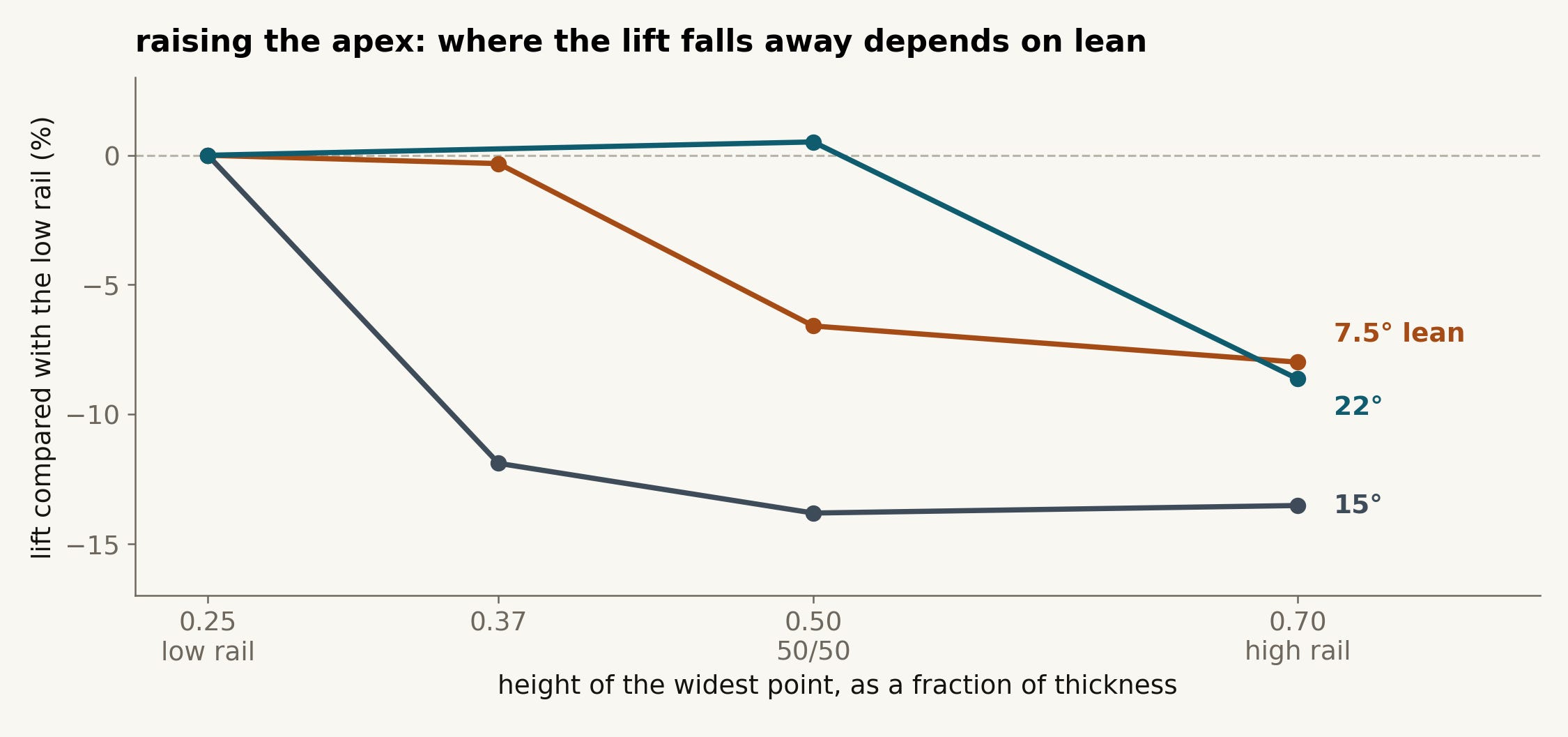
The apex is the biggest lever on rail shape I tested, and its effect changes with lean. At 7.5 degrees the low rail makes 7 percent more lift than the 50/50 and 9 percent more than the high rail. At 15 degrees it beats both by about 16 percent. At 22 degrees the low rail and the 50/50 are tied and the high rail is 9 percent down. A fourth rail, with its apex at 0.37 of the thickness, matches the low rail at 7.5 degrees and drops to the 50/50’s number at 15. The apex height where the lift falls away shifts with how hard the board is leaned.
The lift has a price: the low rail drags 3 percent more than the 50/50 at 7.5 degrees and 11 percent more at 15. It still returns more lift per pound of drag at both angles.
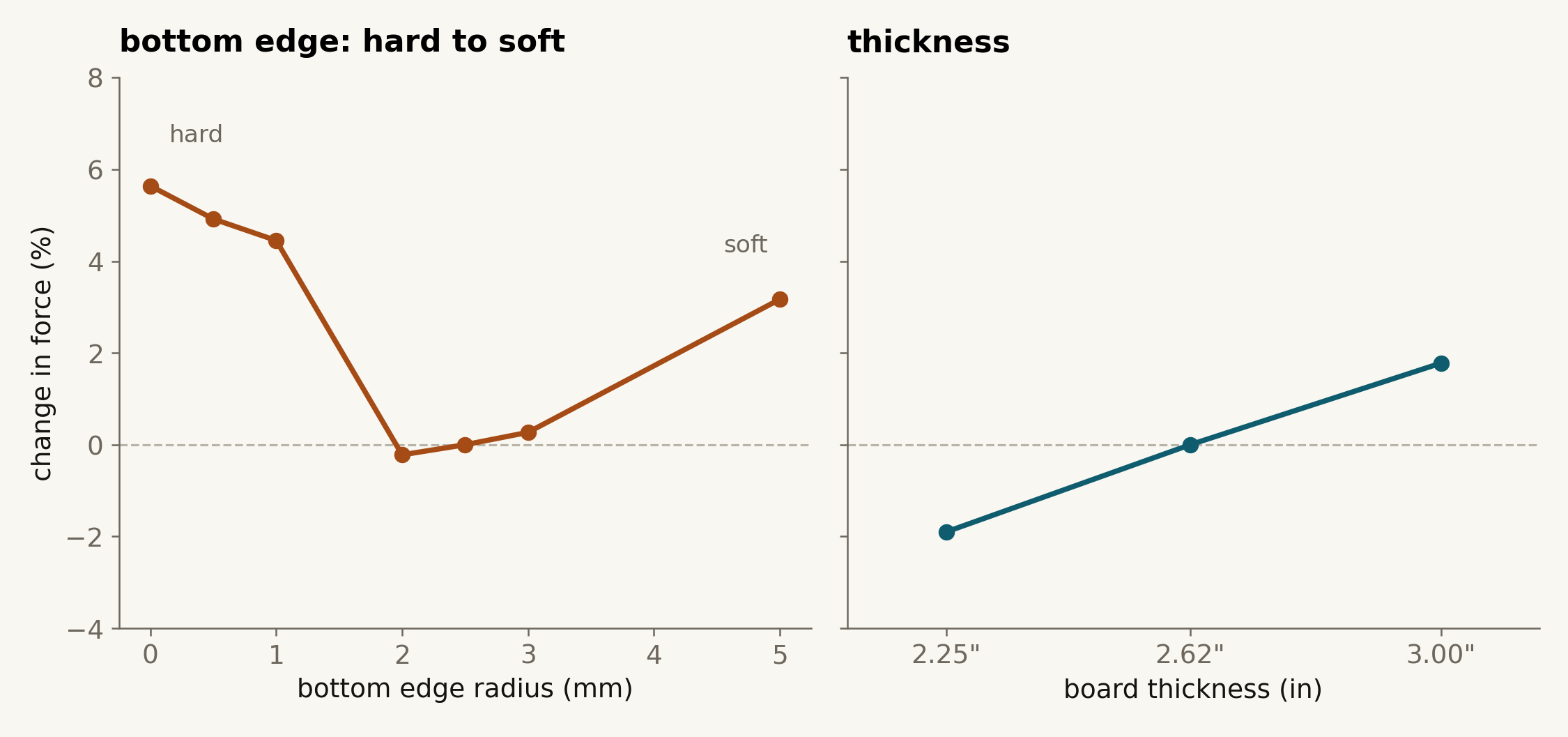
The second biggest lever is the bottom edge, where the rail meets the flat. A shaper can leave it hard or sand it soft (more gentle curvature). I only measured this in the underwater runs, with the rail meeting the water head on, so I trust the direction of the effect more than its size. A radius of 2 to 3 millimeters gave the least force. A hard edge gave about 6 percent more and a fully soft one about 3 percent more. The hard edges also made the flow unsteady, with the force wobbling from moment to moment where the softer ones held still.
Thickness is the smallest of the three. Between a 2.25 inch board and a 3 inch one, the force moved about 2 percent either side of the 2.62 inch slice I used everywhere else.
Although this is a neat look at board rails, it is just one cross-section of one board at one speed, held at a fixed depth. A real board has rocker, outline, and fins, it has water running along the rail as well as across it, and it carries a surfer who shifts weight until the forces balance. The absolute pounds are soft: a coarser grid in the solver read 6 percent lower. The differences between rails hold up better. Repeat runs with a slightly different time step landed within three quarters of a pound of the originals, and the gap between the low rail and the 50/50 at 15 degrees is 3.4 pounds. Before any rail went in, I ran the setup against a published flat plate case from Rezaei, Ghassemi, and Noshadi (2015), where it reproduced their trends with speed and angle, and against Kramer, Maki, and Young (2013), where its peak pressure landed within about 10 percent of theirs.
So the ladder runs like this. Lean moves the force on the rail by 55 percent. The height of the apex moves it by up to 16. The bottom edge and the thickness move it by a few percent each. How a board is leaned counts for several times more than what the shaper carves into its edge, but what the shaper carves is still large enough to measure: open the Rail Lab →
This is the fourth post of our First Order series. Tools accompany each piece, so they arrive when the tool is done rather than on a schedule. All tools are free and open-source, built for the curious surfer. If you know the numbers on your own rails, I would like to hear how the Rail Lab’s reading compares with how the board feels.
Further Reading: