

The San Diego River at Fashion Valley normally carries about 14 cubic feet per second, a flow you could feasibly wade across. At 9:22 on the night of January 22, 2024, it was moving 2,830 cubic feet per second, roughly 21,000 gallons every second, five miles upstream of the surf at Ocean Beach. Two and a half inches of rain had fallen at the airport between six that morning and noon, a quarter of a normal year in one morning, and the river injected it into the Pacific over the next week.
How much water actually made it to the ocean? To answer this, we are going to lean on many approximations. Rain never falls evenly across a watershed but, in order to actually make a conclusion here, we are going to pretend it does. Eleven watersheds drain this county to the coast, but we will follow only one of them. Luckily for us, the measurement location is not too far from the outlet which gives us a solid confident outcome despite these.
The most intuitive visual for what happens to rain that falls over land is a roof with gutters. Nothing soaks into shingles, so every drop that lands on a house leaves through the gutter, and if the land worked the same way the math would be easy. The San Diego River drains 429 square miles above the Fashion Valley gauge, running from the Cuyamacas down through Santee and into Mission Valley. One inch of rain on one square mile is about 17 million gallons, and the airport recorded 3.37 inches over the four days of the storm, so roughly 25 billion gallons landed on that 429 square miles. A roof of that size would have delivered all 25 billion gallons to the surf at Ocean Beach.
But the gauge measured about 1.8 billion gallons, only seven percent of the roof number. An obscene amount of runoff, but where did the other 93 percent of the rain go?
El Capitan Reservoir collects runoff from 188 square miles of the upper watershed and San Vicente Reservoir another 74 square miles, which together is 61 percent of the land draining to the river, and both sat well below their spillways through the storm. Nothing went over the top of either dam, so the rain that made it into those two reservoirs stopped there. That still leaves 167 square miles of open ground draining freely, which caught about 9.8 billion gallons that has a shot at breaking free to the ocean.
Of the 9.8 billion gallons, a large majority soaked into the soil. Soil takes water at a limited rate. Water works into the pore spaces between grains, and as those spaces fill, the rate at which the ground can accept the next drop drops with them. San Diego had seen more rain in those three days than in the three previous months, so the ground started with most of its pore space empty and spent hours drinking before being overwhelmed. During a short rain the storm ends before the soil fills. During a long one the soil can’t keep up, and the hillside starts shedding water like our idealized roof.
Pavement, on the other hand, has no pores to fill first. Asphalt, roofs, and concrete take nothing, so the water that lands on them starts moving immediately and reaches a storm drain in minutes. You can see the split in the gauges. Everything above Mast Road near Santee, 368 square miles of it, sent about 909 million gallons downstream during the storm. The last 61 square miles between Santee and Mission Valley, mostly roofs and streets and freeway, sent about 895 million gallons. A seventh of the watershed produced half the water, and it moved fast enough that the whole storm showed up at the gauge as one sharp spike.
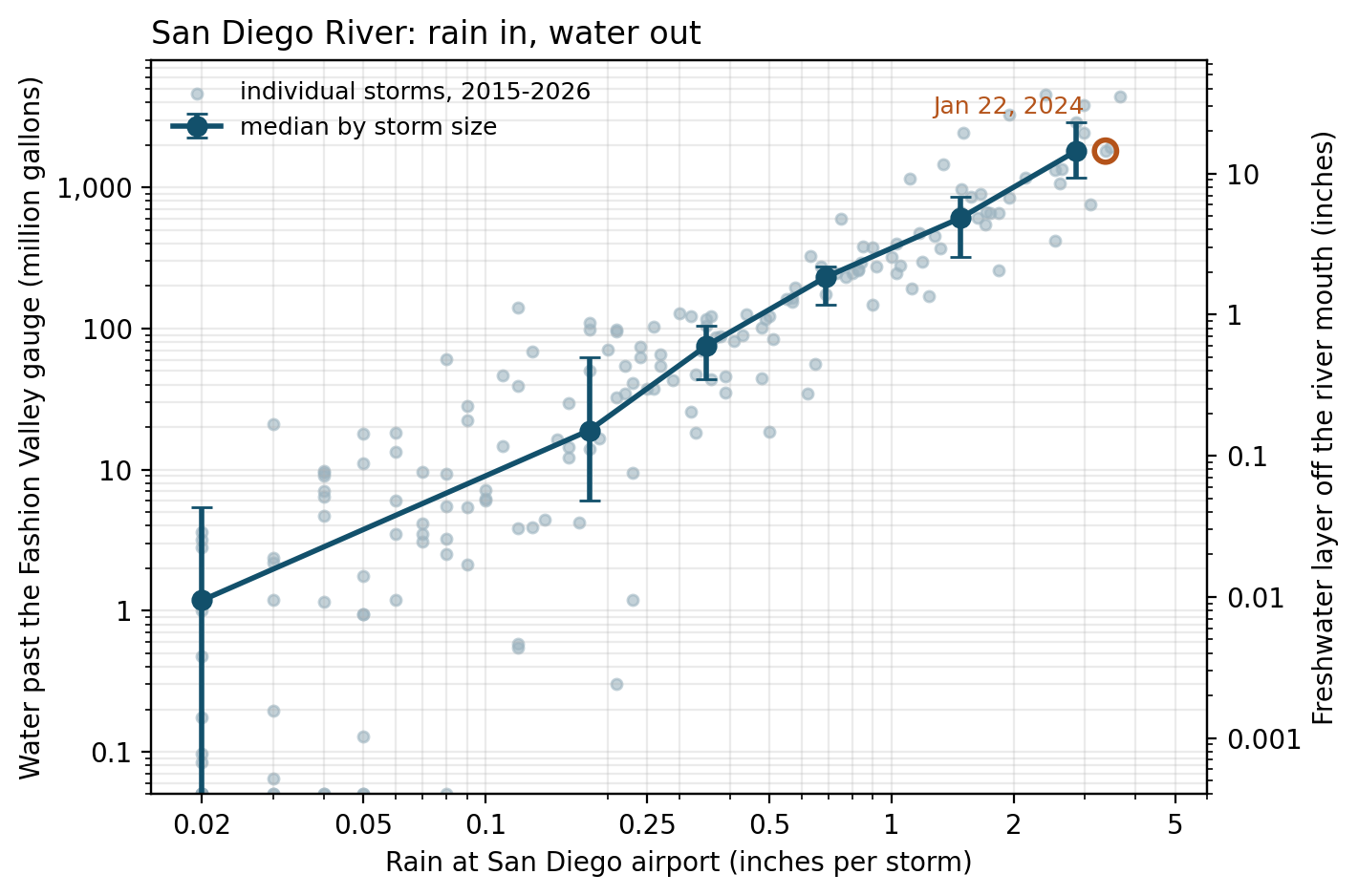
But most San Diego rain is nothing like that storm. It usually falls two tenths of an inch and stops by lunch. I ran the same calculation on eleven years of airport rainfall and gauge records, split into 213 separate rain events, and the small ones still move real water: a fifth of an inch sends about 19 million gallons down the river, while two thirds of an inch sends about 230 million gallons. The fraction reaching the ocean climbs from about one percent in a light rain to a few percent by half an inch and close to ten percent in a storm like January 2024, because the soil keeps filling and more of the watershed starts behaving like the pavement.
[FIGURE: rain per storm vs water past the Fashion Valley gauge, 213 events, 2015 to 2026]
All of that water arrives fresh(ish), and fresh water is lighter than seawater, so it doesn’t mix in on contact. It spreads across the surface as a lens, over a foot deep in January 2024 if it covered six miles of coast and a mile offshore, and sits on top of the surf zone until wind and waves work it down. Everything the water crossed on its way off the land is riding in that lens, which is the real reason nobody should paddle out for three days. A fifth of an inch of rain doesn’t feel like a storm, but it still puts tens of millions of gallons of street water in the lineup.
Further reading: