

Absolutely not. Inspired by the cut on my palm from catching my board after eating it, I had to think whether the fins that I have really need to be as sharp as they are. I can see the logic, sharp fins “cut” through the water, but that’s not how water actually works.
A fin moves through water at a Reynolds number of a few hundred thousand to half a million. In most basic terms, the Reynolds number is a number that allows us to predict how a fluid will flow at certain speeds, viscosities, densities, etc. That number fixes the thickness of the boundary layer, the thin film of water that clings to the fin and gets hauled along with it. For fins on a surfboard, that layer is about a millimeter thick.
Anything sharper than that millimeter is buried inside the boundary layer. Water flowing past cannot tell a honed edge from one rounded off with a few passes of sandpaper, because both sit beneath that film, down in the slow viscous layer the free stream never directly touches. So you can polish the edge to a razor and the water keeps seeing the same blunt millimeter of sluggish fluid wrapped around it.
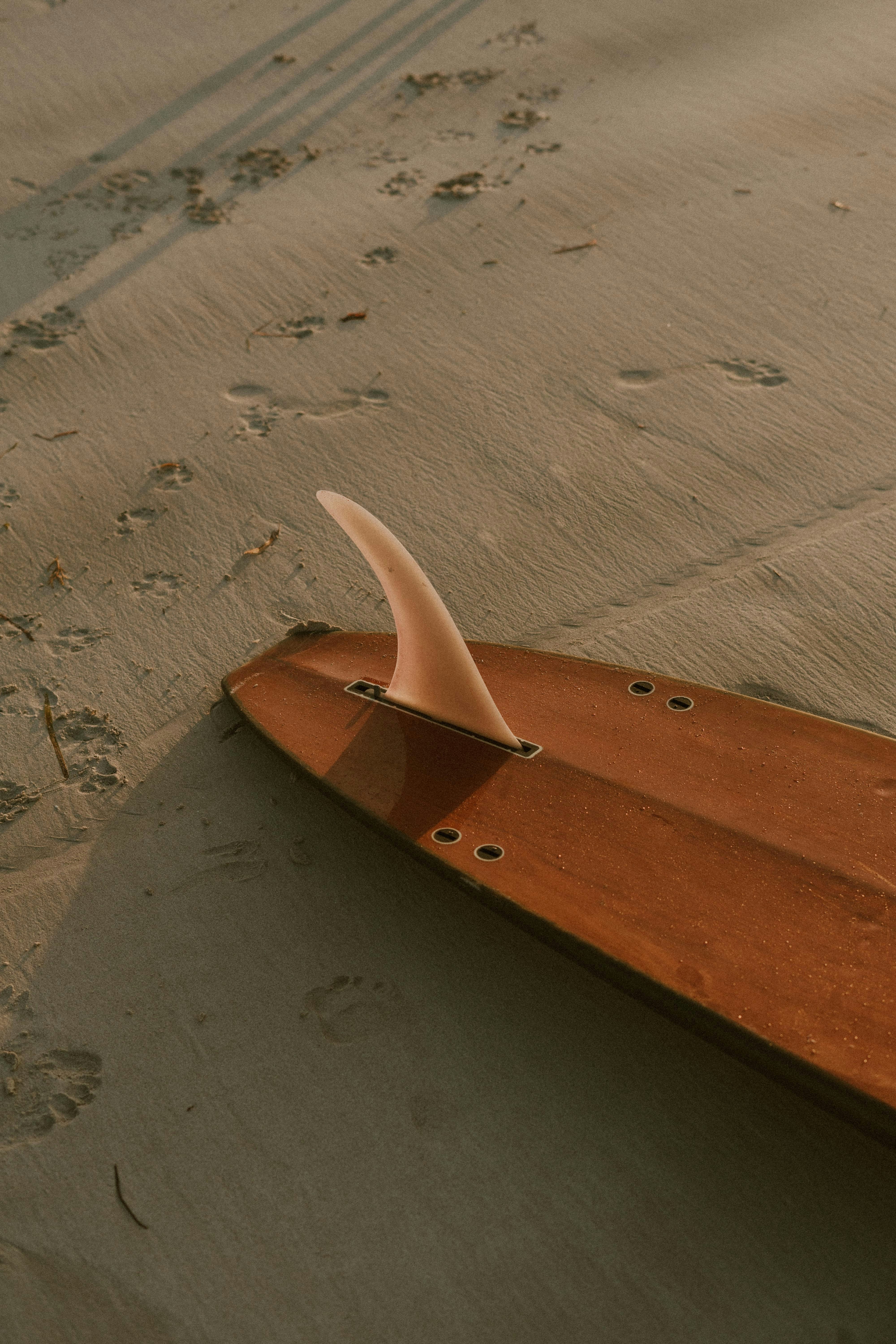
There is one real catch, and it sits at the trailing edge. A thick, blunt back end drags, so thinning that edge genuinely helps. But the gain is about thickness, not sharpness. Once the trailing edge is down to roughly a millimeter, it is as fast as it will ever be. Grinding it past that into a blade does nothing the water can feel, and only leaves you an edge that chips on the first rock.
On the other side of the fin, a sharp nose makes the water whip around a tight corner, and the flow peels off the fin too soon. The fin loses its grip and the tail slides out. Rounding the nose off causes the water to bend around it smoothly, so the fin holds longer and lets go gently when it finally does, instead of all at once.
The rails are no different from the trailing edge. They sit under the same millimeter of clinging water, so sharp or rounded, the flow cannot tell. The tip is the only place a point even looks useful, because that is where water spills around the end and spins off into a little vortex. But how strong that vortex gets depends on the size of the tip and the angle it sweeps back at, not on whether the last few millimeters come to a needle.
So, let’s stop making knife blades on the bottom of boards, shall we? There is little benefit and boy can it hurt you or others.
Further Reading:
Fully agree with this! I bought some fins online and they nearly cut me and my wetsuit in the water the first time I tried them. I think also unless you’re Kelly Slater and need to be dialled in, there are so many other areas of performance to improve (for me anyway, my pop up will always come before equipment improvements)