

Paddling is most of what we do out there. Between paddling out, jockeying for position, and chasing down waves, your hands spend far more time in the water than your feet spend on the board. Surfers have debated hand position for metaphorical generations. The two schools of thought: squeeze tight so water can’t escape, or relax and let the fingers fall where they may. Finally, a topic where the science is surprisingly clear.
A relaxed hand with fingers slightly apart outperforms a tight, squeezed hand. Multiple studies from research groups across Europe and Australia land on the same finding: a small spread of 3-8mm produces 5-10% more propulsive force than fingers pressed together. Marinho and colleagues at the University of Porto used CT scans of an Olympic swimmer’s hand to build three computational fluid dynamics models: fingers closed, small spread (3.2mm), and large spread (6.4mm). Across every angle of attack they tested, from flat to nearly vertical, the small spread consistently produced the highest drag coefficients. Not the closed hand. Not the wide spread. The relaxed middle ground.
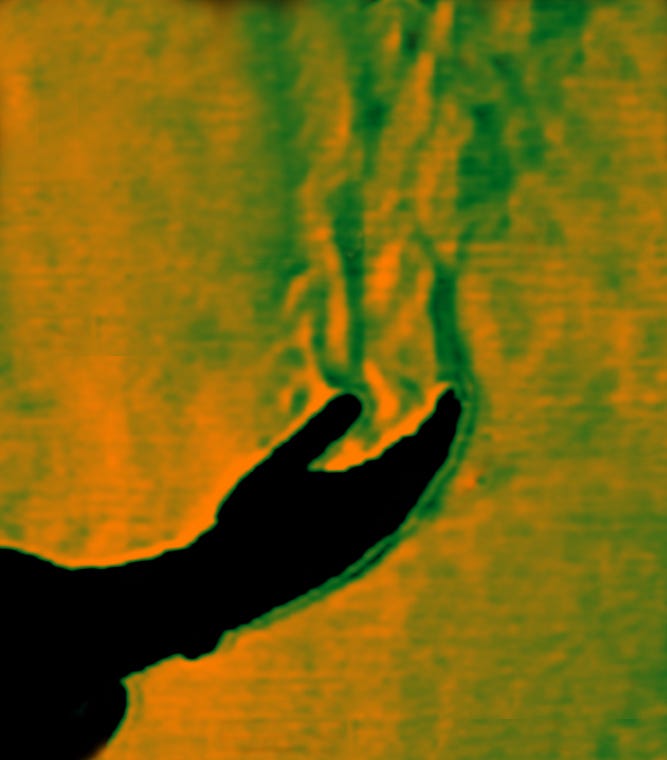
Each finger drags a thin layer of slow-moving water along with it as it moves, called a boundary layer. When fingers are spaced just right, these boundary layers overlap between the gaps without merging completely. Water trying to pass through encounters this zone of slower-moving fluid and gets deflected around instead. Your hand effectively acts like it has more surface area than it actually does. Spread your fingers too far apart (more than about 15mm) and water passes through freely, losing the benefit. Keep them pressed together and you never create the overlapped mitten in the first place.
Why obsess over a few millimeters of finger spacing? Because the hand does most of the work while paddling. Your forearm has more surface area, but it’s cylindrical, so water flows around it relatively easily. The hand is flat, and flat surfaces generate far more drag when pushed through fluid. This is why swimming research focuses so heavily on hand position, and why those small percentage gains from optimal finger spread actually matter.
The optimal spacing, that 3-8mm range or roughly 10-12 degrees between fingers, matches almost exactly what your hand does when relaxed. The natural position of an unstressed hand falls right in the performance sweet spot.
There’s no need to think about millimeters mid-paddle. Just stop squeezing.
Further Reading:
I have always wondered this