

Getting more into surf fishing recently, I’ve spent a lot of time at the water’s edge. Watching the waves come and go, I’ve seen lots of shapes form in the sand. Most are V-shaped, pointing away from the ocean and towards the shore. Looking closer, there are actually a few variants of these features.
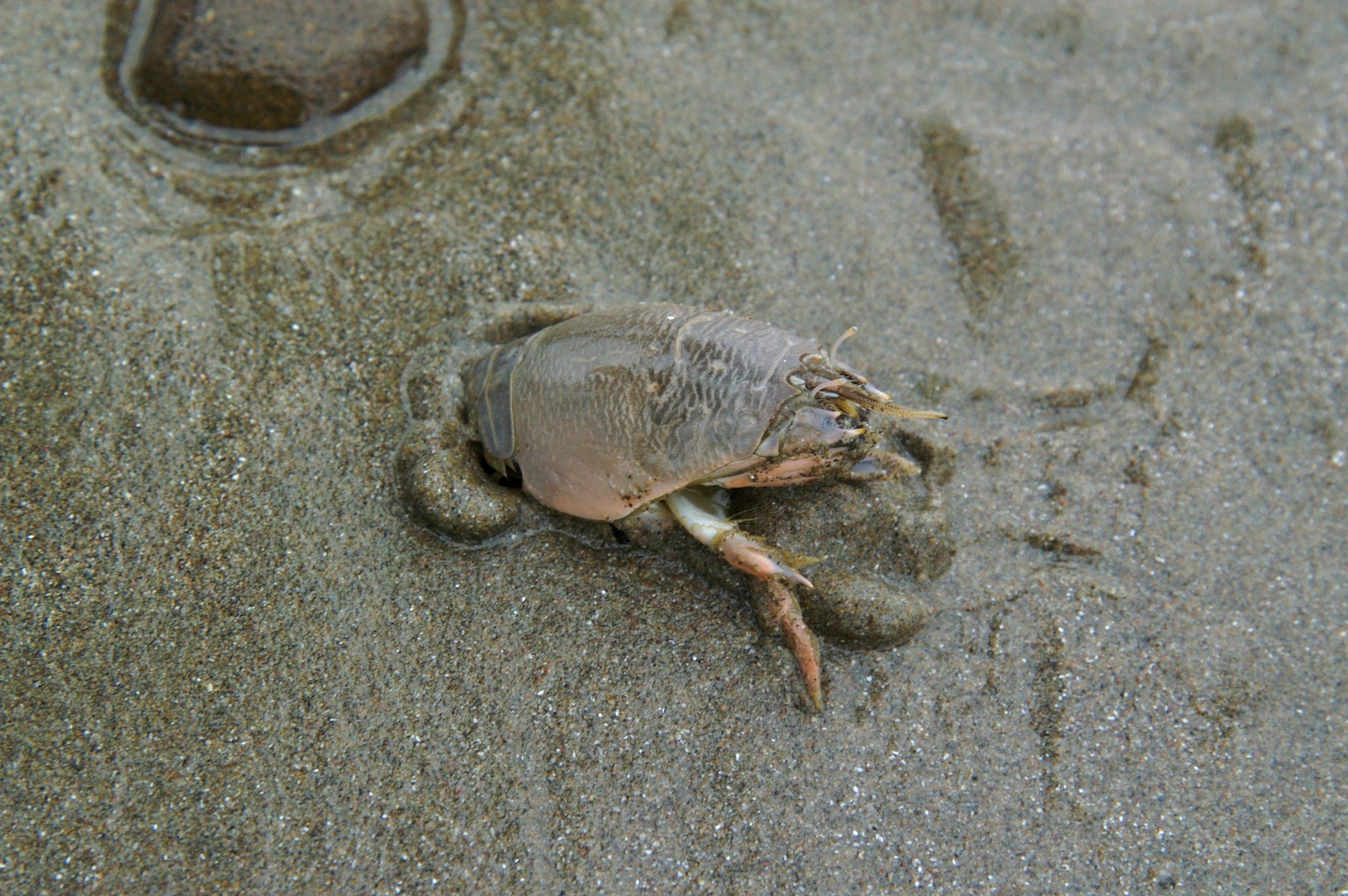
Emerita analoga, aka sand crabs or sand fleas, live buried in the swash zone, dug in tail-first and facing the water, with only its eyes and a pair of antennae poking above the surface. Each time a wave drains back over it, the crab uncoils a second set of feathery antennae and combs the backwash for plankton. They migrate up and down the beach with the tide to stay in that band, and on the right fine-sand beach they pack in by the thousands per square meter, so one bed can stipple a whole patch of sand with V’s.
Backwash thins and speeds up as it runs down the slope, and by the time it’s a sheet a few millimeters deep it’s moving fast enough that anything sticking up throws a standing wake, the same way a rock in a quick creek kicks up a fixed little peak. It holds in place because the water is draining downhill faster than the wake can climb back up against it, so the disturbance gets pinned right where the obstacle is. The flow scours a shallow horseshoe around the crab and trails that wake behind it, which is why the point of the V sits at the animal and the arms open seaward. Finding bait is pretty easy when they’re around.
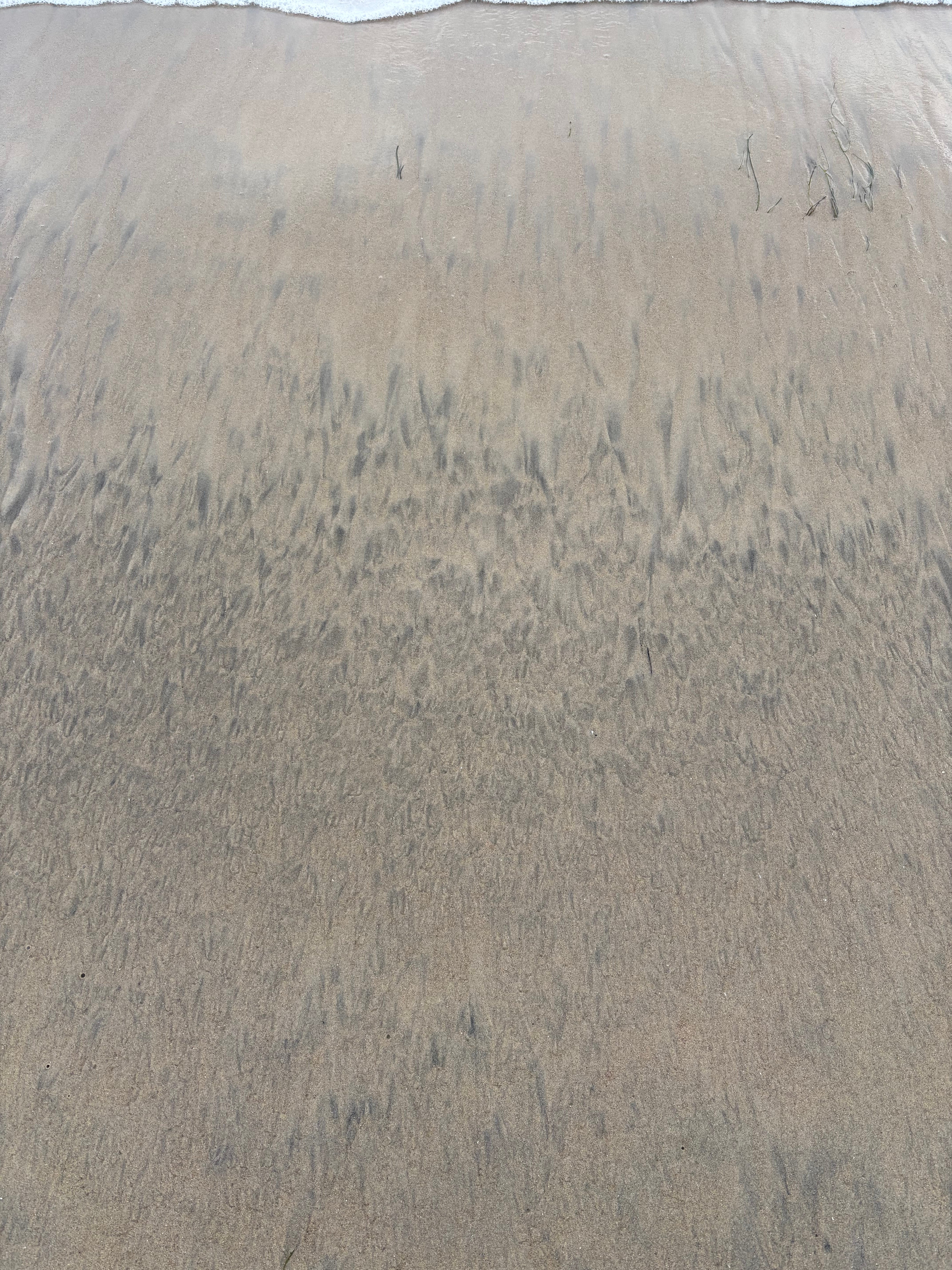
But most of the V’s on the sand aren’t crabs. Walk ten feet up the face to where the sand is tiled edge to edge with the same diamond pattern and start checking the points and you’ll find nothing there. No crab, no shell, no pebble, no bump at the apex of any of them. These are rhomboid marks, and they don’t need an animal, or an obstacle of any kind. The water makes them on its own.
As the thin sheet of backwash drains down the slope, it organizes itself into a repeating lattice, the way fast shallow water patterns up into a regular grid instead of running smooth. The draining flow sets up standing waves, with the angle of the diamonds tied to how fast the sheet moves against the slope. The whole field freezes the direction of the last sheet to leave the beach.
In order to figure out what caused the shape, check the apex. A V with a little lump at its landward point, especially a few of them clustered together, is something solid sitting in the flow, usually a crab, sometimes a shell or the tube of a buried worm. A clean grid of V’s across open sand with nothing at any of the points is just the backwash itself.
Further reading: