

Virginia Beach and San Francisco sit at nearly the same latitude. In summer, Virginia Beach water temperatures run around 24°C. San Francisco’s hover around 14°C. One is nice, the other is frigid.
In the Northern Hemisphere, trade winds blow westward across the tropics and westerlies blow eastward across the mid-latitudes. When these two wind belts push on the ocean surface in opposite directions at different latitudes, the water ends up spinning in a large clockwise loop called a gyre. The North Atlantic and North Pacific both have one, and both spin in the same direction. The difference is what happens on each side.
The Coriolis effect, which deflects moving objects to the right in the Northern Hemisphere, causes water to pile up in the center of each gyre. That creates a slight pressure gradient, and the whole system reaches a balance called geostrophic flow: water circling around the central mound rather than draining out of it. You’d expect the return flow to redistribute itself evenly around the gyre. But the Coriolis effect isn’t constant. It weakens toward the equator and strengthens toward the poles, and that variation breaks the symmetry. The return flow can’t spread itself evenly east to west, so it piles up on the western side of the basin instead. The result is a fast, narrow, deep, warm western boundary current.
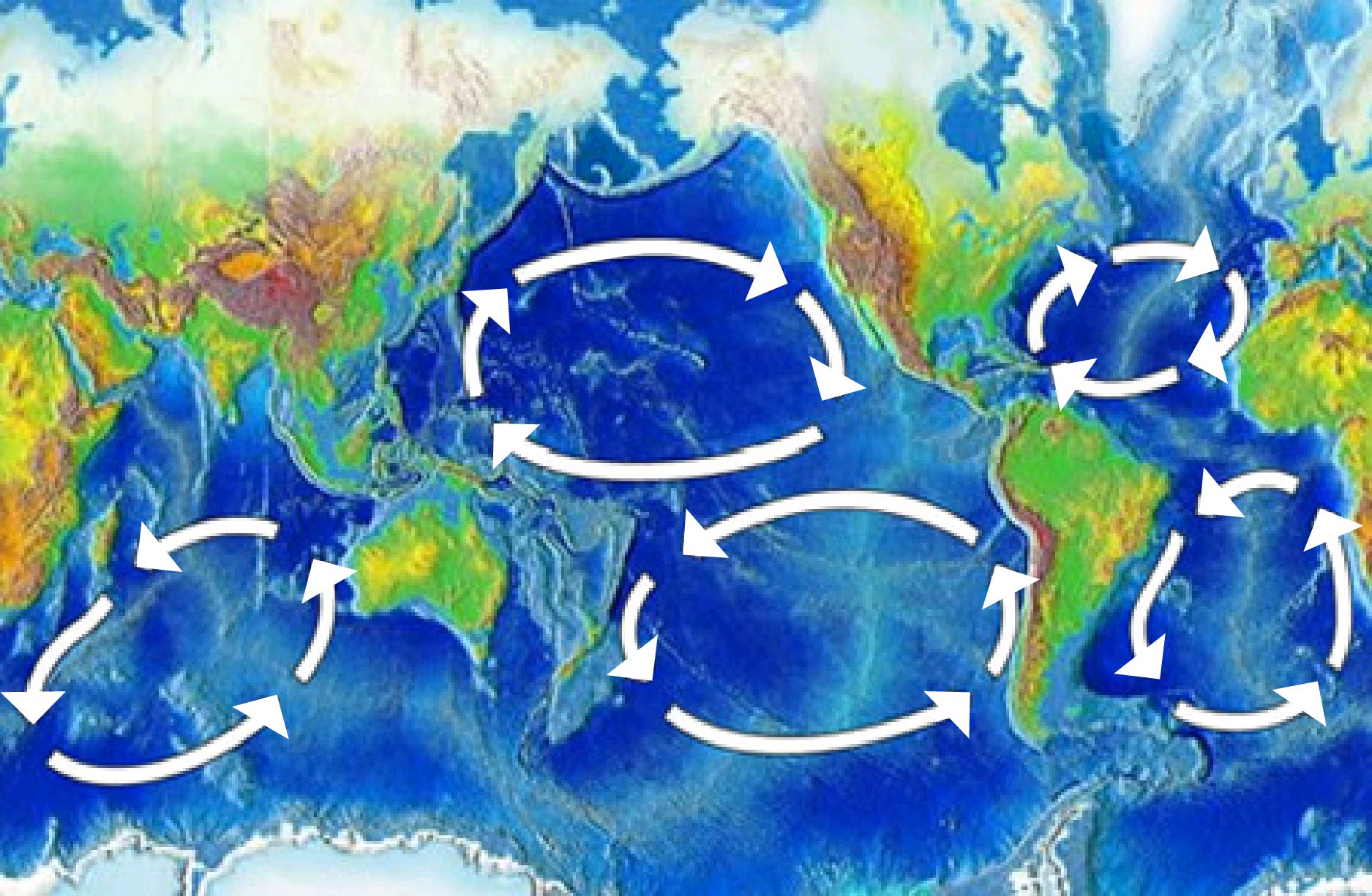
In the Atlantic, that’s the Gulf Stream. It moves roughly 30 sverdrups of water — the equivalent of over 12 thousand Niagara Falls — in a current sometimes under 100 kilometers wide. It carries warm tropical water northward along the East Coast before peeling northeast toward Europe, and it keeps the water warm well offshore. Standing on the beach in North Carolina and dipping your toes in, you’re feeling sometimes-disturbingly-warm water that started near the Caribbean.
The California Current is the eastern boundary current of the North Pacific gyre. Eastern boundary currents are slow, broad, shallow, and cold. Rather than a concentrated ribbon of warm tropical water, the California Current is a wide drift of subarctic water moving southward down the West Coast. Broad and slow means less heat, more time for mixing, and a lot of exposure to persistent northwesterly winds that push surface water offshore. When that surface water gets pushed out, cold water from depth wells up to replace it. This upwelling is why the California Current is one of the most biologically productive systems on the planet and also why 4/3s are awesome.
This asymmetry is a feature of every major ocean basin. The warm Kuroshio Current runs up the eastern coast of Japan the same way the Gulf Stream runs up ours. In the Southern Hemisphere the gyres spin counterclockwise, but the same Coriolis asymmetry applies — western boundary currents still pile up on the western side of the basin, meaning the eastern coasts of continents still get the warm side. Brazil gets the Brazil Current; Chile gets the cold Humboldt.
Further Reading: