

Anyone who has entered or exited between some jetties on a boat knows the ride changes with the tide. The same swell that allowed a smooth bar crossing at a slack or rising tide now stacks into short, steep walls.
Waves propagating into an opposing current slow down relative to the seafloor. The period stays locked, set by whatever storm generated the swell, but wavelength has some wiggle room to adjust. Wavelength equals speed multiplied by period, so slower propagation means compression. The same wave energy now occupies less horizontal space, and that increased energy density translates directly to larger waves and steeper wave faces.
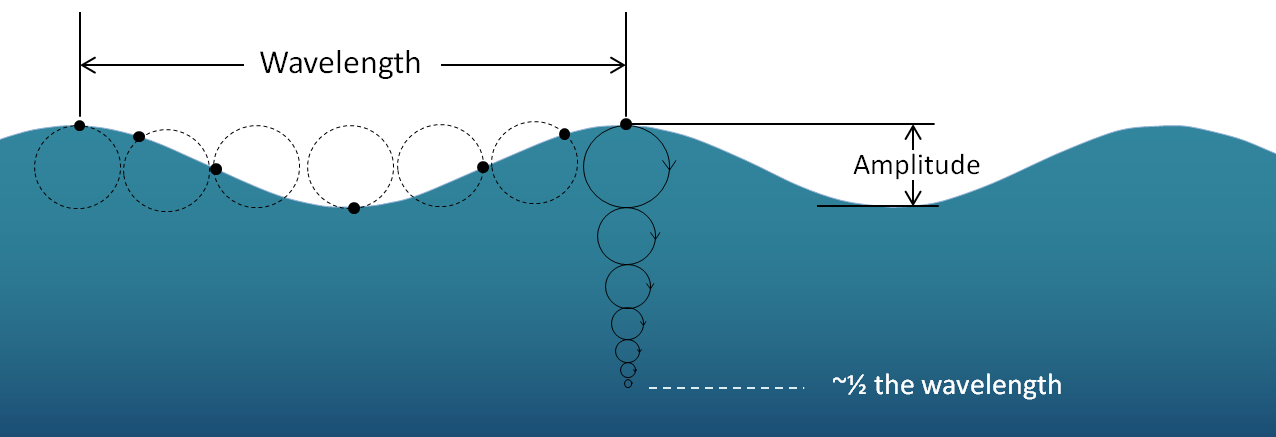
In 20 feet of water, waves behave as shallow water waves, their speed set by depth rather than period. The phase speed works out to about 7.7 m/s. A 2 m/s ebb current cuts that ground speed to 5.7 m/s, a 26% reduction. Wavelength compresses by the same proportion, and wave height increases as the energy concentrates into a shorter space. A swell that was nowhere near breaking can cross the steepness threshold just by running into an outflow. This follows conservation of wave action, a quantity that accounts for both wave energy and the medium carrying it. Wave energy alone isn’t conserved when currents enter the picture, but wave action flux is.
If we flip the scenario, everything reverses. Waves traveling with a current stretch out, their peaks getting further apart from each other. The following flow adds to ground speed, flattening wave faces. That same bar crossing becomes forgiving on the flood tide. You time your crossing with the tide.
When currents run at an angle to wave direction, things get more complex. Waves refract toward slower water, bending their propagation direction in response to velocity gradients. We usually think of refraction as a depth effect, waves turning as they hit a shallower bottom. But currents are also out there bending waves. An alongshore current means one portion of the wave crest moves faster over ground than another. The crest rotates. This current-induced refraction can steer swells toward or away from the coast independent of what the bathymetry is doing.
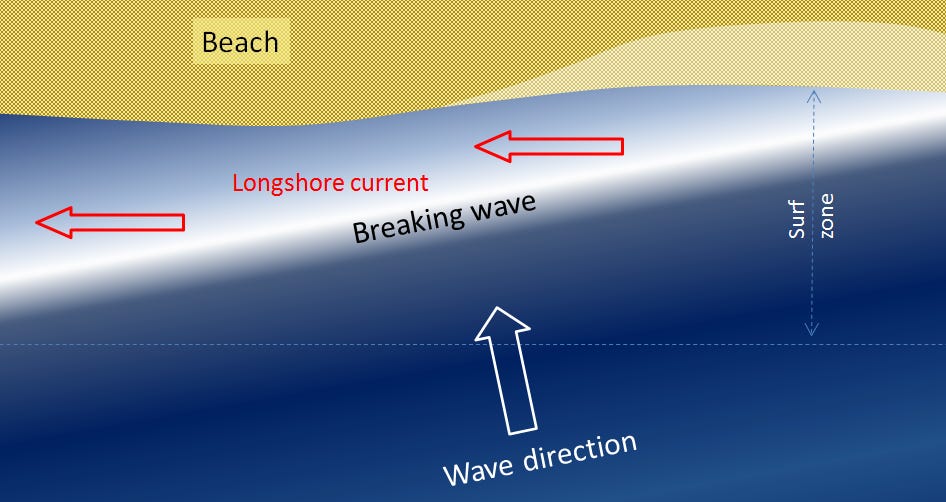
Creek and lagoon outflows during ebb tide show this clearly. Breaks near harbor entrances or river mouths change character through the tidal cycle for exactly this reason. The steepening is localized where velocity gradients are sharpest, and those zones shift position as the tide ebbs and floods.
The surface texture reveals what’s happening below. Opposing current creates a rougher, choppier appearance with compressed wave spacing. Following current smooths things out. Where current shear is strong, visible lines form on the surface, foam and debris collecting along the boundary. These cues help whether you’re timing a bar crossing or just trying to understand why the waves look different at different points in the tide.
Further Reading:
I was surfing small waves on an out going tide this morning. It was good but as the tide ran out the rip spread over the bank and pretty much screwed it. Hard to find the line up, shifting peaks, general weirdness.
Great post. Where I surf I've heard other surfers say an incoming current helps increase the quality of the swell (including size) whereas an outgoing current "knocks the swell" down". Others have told me an outgoing current helps the waves stand up, which seems to follow the logic you've presented. So are incoming currents in no way beneficial for surf quality?