

Wind farms are going up off both coasts, and the first thought for a small minority of the world is whether a few hundred turbines parked on the horizon will flatten the swell before it reaches the lineup. Whether the turbine stands on the seabed or floats on the surface seems to matter. For most of what is in the water now, the surf is fine. For what is coming, it depends.
Turbines pull momentum out of the air, and downwind of the array sits a wake of slower wind that can run for tens of kilometers. Less wind over the water means less energy feeding the waves growing under it. The modeling puts the result at a few percent off the wave height near the farm, fading to almost nothing within twenty kilometers or so. It lands mostly on the local chop being generated right there, not on the long-period groundswell that was generated far away.
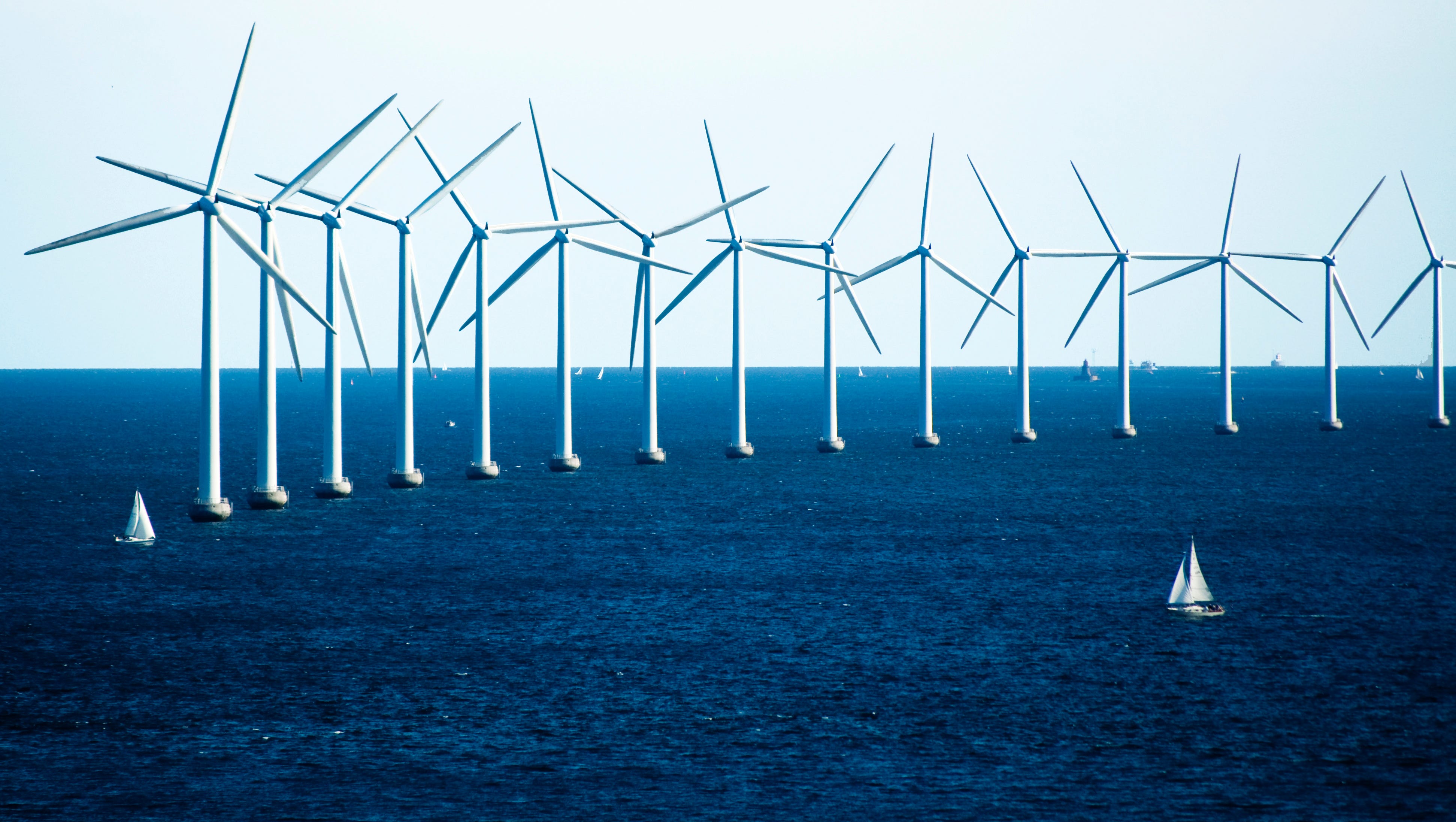
A bottom-mounted turbine sits on a single pile maybe ten meters across. Setting that against a swell whose crests run two or three hundred meters apart, the pile is a pencil standing in a doorway to the shelf. It scatters a sliver of energy, nudges the direction a touch, and the effect on wave height comes in under a few percent.
A few hundred piles in tidy rows looks like it should reflect waves back out to sea, the way evenly spaced bars on the seabed bounce a swell (Bragg reflection). The usual dismissal is that the spacing is wrong, that piles a kilometer apart would need a two-kilometer wave to resonate and surf is far shorter than that. The dismissal itself is wrong, however. The reflection also happens at higher multiples of the spacing, so a coarse grid does not fail to resonate, it just resonates with the swell at a higher order.
The piles block maybe a percent of each row, the rows are never perfectly spaced, and real swell shows up smeared across a band of periods and angles. Sharp reflection needs a dense, precise lattice and one clean wavelength, and a wind farm is none of those. A little energy comes back at a few specific frequencies, but most slips through.
So for the farms standing on the seabed today, the swell crosses the array and arrives about the way it left. If anything the water is slightly cleaner, since the wind the farm skims off would otherwise be stacking up chop.
Floating turbines are a bit of a different story. They do not stand on a pole, they ride on a platform of fat, half-submerged columns, and a column that wide compared to the wave does not diffract neatly. Idealized modeling has a single floating platform cutting the wave height behind it by more than half under the right conditions, with a shadow trailing about a kilometer downwave.
Whether a shadow a kilometer long still matters several kilometers down the line is genuinely unsettled, tangled up in how fast the wave field heals around the gap. The waves we ride should mostly survive the steel bolted to the seabed. The ones riding on top are worth watching.
This is an article based on a comment from Dr. Lonneke Goddijn-Murphy of SeaLetters on a previous article. If anyone has a question they want answered, I’d love to hear it.
Further reading: